Back

Discover CALS

See how our current work and research is bringing new thinking and new solutions to some of today's biggest challenges.

Share
  • Biological Field Station
  • Natural Resources and the Environment Section
  • Natural Resources
  • Fish

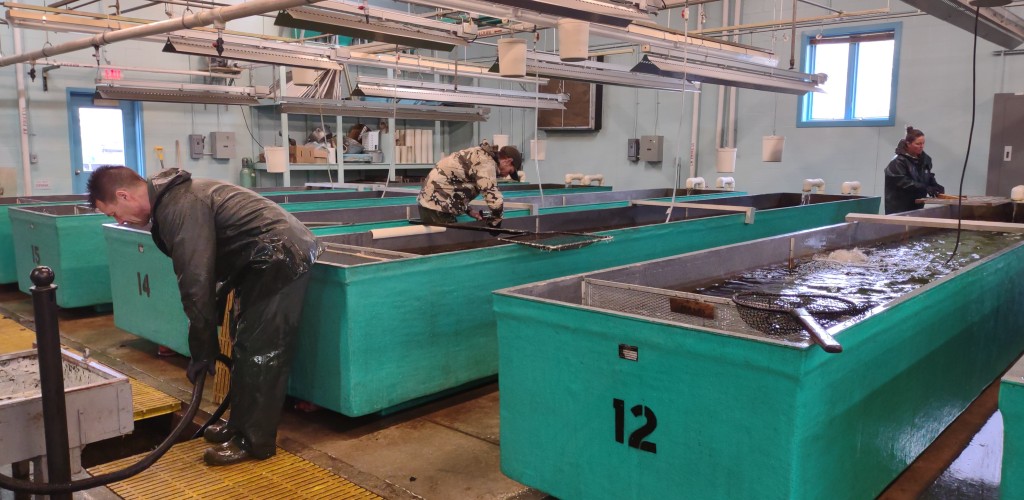
On April 12, 2022, Cornell Field Station staff completed the marking portion of the 2022 Oneida Lake walleye mark-recapture population estimate. Over 21,000 adult walleye were marked with a fin clip and released back into the lake. Later in the summer and fall, walleye will be collected throughout the lake and the ratio of marked to unmarked walleye will allow researchers to estimate the population. Oneida Lake is home to the State’s most valuable walleye sportfishery. 

This study is conducted in cooperation with the NYSDEC Oneida Fish Cultural Station located in Constantia, New York. Hatchery personnel set nets around the mouth of Scriba Creek, a known walleye spawning tributary of Oneida Lake, to collect male and female walleye as they prepare for spawning. Walleye are brought into the hatchery and stripped of their eggs and sperm. Once stripped, fish are marked by Cornell staff and then released back into Scriba Creek.

Fertilized eggs are transferred to hatchery jars where they will incubate for about 3 weeks until hatching. Most of the newly hatched fry are then stocked back into Oneida Lake, with the remainder being held and raised to fingerling stage and stocked in other NYS waters. This is the State’s only walleye hatchery and is the source of fish for the entire walleye propagation program.
Cornell Biological Field Station conducts research in fisheries and aquatic ecology in New York State with a focus on Oneida Lake, the Great Lakes and other NYS inland lakes, and supports the educational, outreach and extension programs of the Department of Natural Resources and the Environment (DNRE), the College of Agriculture and Life Sciences (CALS), and Cornell University.

Keep Exploring

person standing next to poster at conference

News

The New York Chapter and Northeastern Division of the American Fisheries Society annual meeting was held in Saratoga, New York, from February 4-6. Seven Cornell Biological Field Station (CBFS) representatives attended, including Tom Brooking...
  • Biological Field Station
  • Ashley School of Global Development and the Environment
  • Natural Resources and the Environment Section
person standing front of aquatic tank

News

Kelsey Alvarez del Castillo published the second paper documenting her studies on round goby in the Transactions of the American Fisheries Society in January 2026. Round Goby are a highly invasive fish species that have recently invaded the...
  • Biological Field Station
  • Ashley School of Global Development and the Environment
  • Natural Resources and the Environment Section