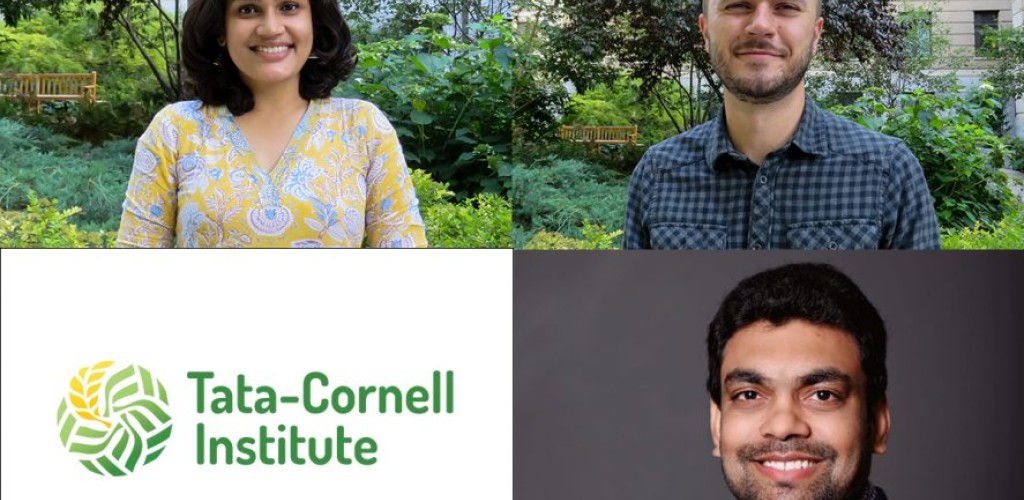
The new scholars, Apurva Borar and Whitman Barrett, are pursuing doctoral degrees in applied economics and management and soil and crop sciences, respectively. Kasim Saiyyad, who earned a master’s in applied economics and management in May 2021, is now working towards a PhD in the same field.
Borar’s research interests lie at the intersection of development economics and gender studies. She is also interested in politics, governance, culture, and identity studies. Prior to joining Cornell, she worked as an assistant professor of economics at Miranda House at the University of Delhi.
Barrett’s research focuses on the reuse of human excreta in agriculture, with the goal of improving smallholder farmers’ productivity and resilience to climate change. He was previously a Peace Corps volunteer in Togo, and he earned an MPS in Global Development from Cornell.
Saiyyad has been a part of TCI for years, starting as a project lead for the Institute’s Sfurti program, which aimed to reduce iron deficiency through home-based flour fortification by women’s self-help groups. He is interested in agriculture and nutrition economics, with a focus on public welfare programs in low- and middle-income countries.
TCI scholars are master’s and PhD students at Cornell University whose research aligns with TCI’s commitment to improving nutrition outcomes and livelihoods in India and other developing countries. There are currently 16 scholars studying at the Institute.
This article originally appeared on the Tata-Cornell Institute website.