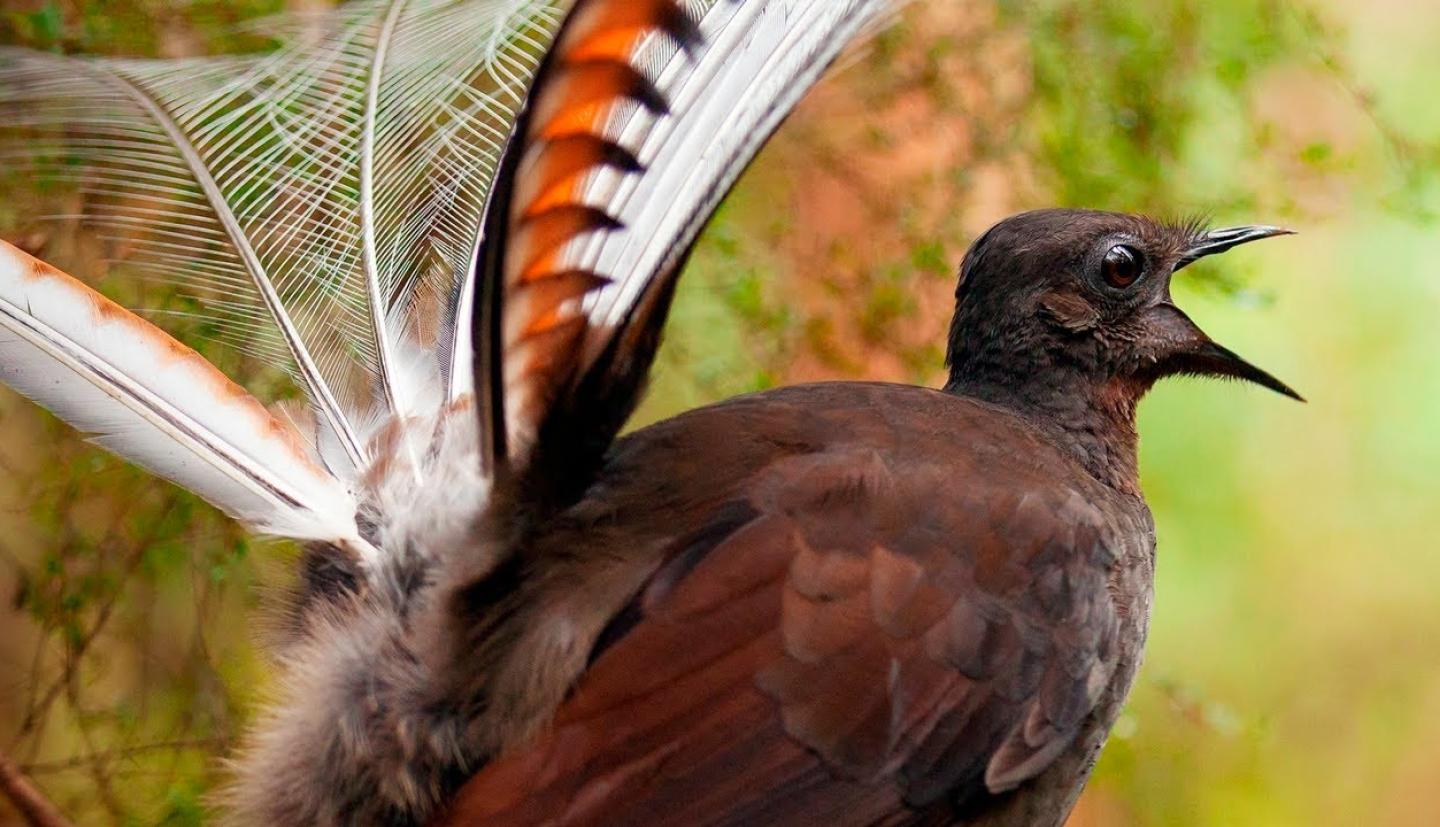
“The male superb lyrebird creates a remarkable acoustic illusion,” said Anastasia Dalziell, a Cornell Lab of Ornithology associate and recent Lab Rose Postdoctoral Fellow, now at the University of Wollongong, Australia, and first author of “Male Lyrebirds Create an Acoustic Illusion of a Mobbing Flock During Courtship and Copulation,” published Feb. 25 in Current Biology.
“Birds gather in mobbing flocks and the ruckus they make is a potent cue of a predator nearby,” Dalziell said. “The male lyrebird recreates that sound when a potential mate tries to leave a displaying male without copulating, or during copulation itself. These two moments are key to male reproductive success, suggesting that mimicking a mobbing flock is a crucial sexual behavior for males.”
While it’s not clear exactly how males benefit from their extraordinary mimicry, they seem to be setting a “sensory trap” for females, she said. The males may gain a reproductive advantage by tricking the female into responding as if she may be at risk from a predator.