With late-breaking internship cancellations and research abroad no longer an option, students were left scrambling to make new plans for summer employment. That’s when Global Cornell stepped in.
Drawing on worldwide connections, from faculty and alumni to international partners, the Mario Einaudi Center for International Studies and Institute of Politics and Global Affairs (IOPGA) rapidly launched a virtual internship program that ultimately matched 35 students with paid summer internships and research in their fields – all in time for virtual work to start in June.
“There was about a month between when my plans got canceled and I discovered this new opportunity,” said Courtney Harris ’22, a biology and Spanish double major. With travel restricted, her scheduled research in Chile was impossible.
Harris applied, and Einaudi’s Latin American Studies Program (LASP) paired her with the Joya de los Sachas municipality in Ecuador. From her home in Buffalo, Harris worked with colleagues in Ecuador to evaluate strategies for developing agricultural policies, government aid and markets for farmers impacted by the pandemic. Harris drafted the group’s 40-page report in Spanish.
Global Cornell created the virtual internships with funding from a U.S. Department of Education grant and gifts from several donors. In a typical summer, the Einaudi Center sponsors about 10 student interns and researchers working around the world. This summer’s effort brought more than two dozen new opportunities for students in need, including research opportunities in an array of areas – from rural development to conservation, global politics, and sensor engineering.
The awards matched student applicants with customized opportunities by mobilizing Cornell’s international networks, including the Einaudi Center’s eight regional and thematic programs and IOPGA’s public policy contacts. Hosting partners included think tanks and international development organizations.
Lilly Thomalla ’22, a policy analysis and management major, was one of eight interns placed through IOPGA.
“This summer made me notice how many resources there are at Cornell for students to tap into,” said Thomalla, who worked with government professor Alexandra Cirone to investigate European Parliament political dynasties.
Pulled together over just a few weeks, these internships were summer-saving opportunities for many – especially international students, who face travel challenges and visa restrictions for off-campus work. More than a third of the awards went to international students.
“I’m from Kenya, and I didn’t want to fly back home because I thought I might face difficulties in trying to get back to the United States,” said Grace Nyambura ’22, a junior majoring in civil engineering. Nyambura researched climate change adaptations with Rachel Bezner Kerr, professor of global development, after her campus employment was canceled.
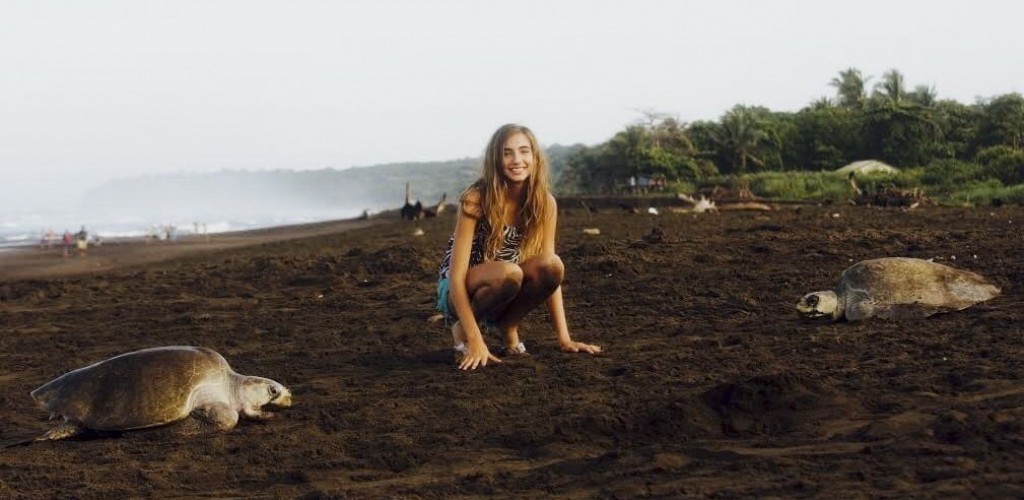
Danielle Berkowitz-Sklar ’22, a junior majoring in development sociology, worked with partners of the Institute for African Development on sea turtle conservation and women’s roles in fishing villages in Ghana. The internship gave her a new perspective on the communities’ values and priorities.
“Having a greater understanding of the needs, beliefs, and roles of these women and the decision-making power they hold in the fishing industry gave me a better understanding of ways they could become agents of change,” she said.
According to Rachel Beatty Riedl, Einaudi Center director and the John S. Knight Professor of International Studies and professor of government in the College of Arts and Sciences, the virtual internships met an urgent need and have potential for growth.
“We are so proud of the excellent work our Cornell students were able to produce with mentorship and professional guidance,” she said. “We plan to build upon this model to increase the flexibility and range of our experiential learning opportunities.”
Priya Pradhan ’22 is a writing intern for Global Cornell.