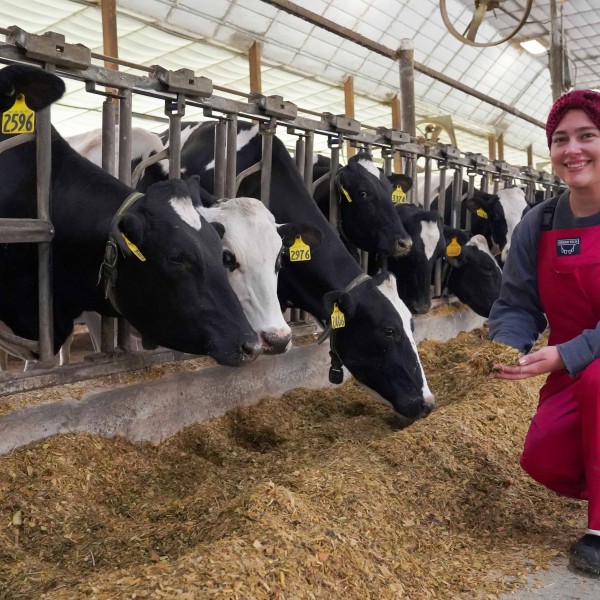
A Cornell-led project will use computer modeling and outreach to find optimal strategies to minimize COVID-19 cases and transmission among workers in food processing facilities, while maintaining the best possible production. Researchers will collaborate with a dozen meat, dairy and produce industry partners to explore potential solutions in real-world settings.
The project was made possible thanks to a two-year, $1 million rapid-response grant from the United States Department of Agriculture’s National Institute of Food and Agriculture.
“This is a problem that requires rapid solutions, we need to solve this right now,” said project principal investigator Renata Ivanek, associate professor in the College of Veterinary Medicine’s Department of Population Medicine and Diagnostic Sciences.
Though the hope is that the pandemic will be quelled in the next year, Ivanek said the project will address current issues while also providing valuable insights for any future disease outbreaks.
Food production is an essential industry. Keeping workers safe is a priority and a challenge since they often need to work in close proximity to each other, increasing the risk of COVID-19 transmission. Many companies have tried to address the risk by shutting down a portion of their production lines and adding plexiglass dividers but this reduces production capacity. Adding to the complexity is that facilities are all unique.
“Part of the project is to investigate how segments of the food production industry differ and how to develop control strategies that will fit a specific industry segment,” Ivanek said.
On the research side, the project aims to develop mathematical models relating how a facility produces food to how COVID-19 spreads in plants, and how one affects the other.
“The goal is to optimize by looking into different interventions that have already been proposed, and in some cases also implemented, and try to find the optimal combination of measures,” Ivanek said.
Once a model has been developed and validated, it will be scaled up and applied in several specific facilities to further validate it in real world settings. Industry partners include produce processors Misionero Vegetables, Del Monte Fresh Produce, Seneca Foods Corporation and Taylor Farms; dairy processor Great Lakes Cheese; and poultry, beef and pork processor Tyson Foods.
In parallel, co-principal investigators, Samuel Alcaine, an assistant professor, and Martin Wiedmann, the Gellert Family Professor in Food Safety, both in the Department of Food Science in College of Agriculture and Life Sciences, will develop and deliver online extension programs for industries.
Outreach will include courses on COVID-19, its biology and how to control it. The Institute for Food Safety at Cornell University has already begun some of this work, including information-sharing office hours that food processing facility managers may virtually join to engage with COVID-19 experts on such topics as safety training for employees and using checklists to assess a facility’s safety plan.
Aaron Adalja, assistant professor of food and beverage management in the School of Hotel Administration, is a co-principal investigator.
Claire Zoellner, a food safety scientist and former postdoc in Ivanek’s lab, and Diane Wetherington, executive chair and founder, both at iFood Decision Sciences, Inc., will serve as co-principal investigator and industry advisor, respectively. iFood Decision Sciences is a software company specializing in food safety, quality and traceability.