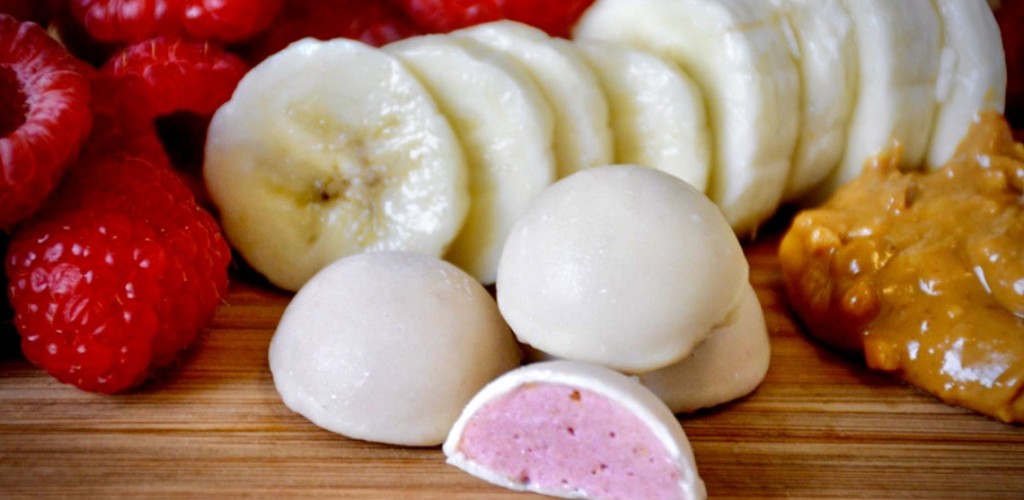
Cornell’s bite-size frozen fruit smoothie pieces with crunchy yogurt coatings earned the top prize this summer at the virtual 2020 Institute of Food Technologists’ (IFT) Student Association & Mars Product Development national competition.
“Smoothie Bites were designed for people who want convenient, frozen healthy snacks that taste like a smoothie, but without the fuss of a blender,” said Allie Hall, a graduate student in food science and a team co-captain.
Smoothie Bites are packed with protein and flavor, Hall said, and feature fiber, vitamin C, strawberries and bananas – and no added sugar.
“You can either eat them straight out of the container as a snack, or you could blend them into a smoothie,” said Kelsey Sheldon ’20, team co-captain. “They’re very healthy.”
The product development team started last fall with a whiteboard brimming with ideas, before deciding on Smoothie Bites. The team analyzed the product’s sensory aspects and freeze-thaw stability; they also engineered the yogurt coating, which keeps it from melting too fast when taken out of the freezer.
“We worked with cocoa butter and coconut oil to ensure the yogurt coating did not quickly melt,” said Nicki Bukovac ’21, noting the cold coating is stable for about 45 minutes out of the freezer.
The team tried several versions in the Stocking Hall Food Product Innovation Lab, then began conducting sensory tests, giving students and faculty a chance to taste the winning flavors.
By early in the spring semester, the team felt it had a winning product. Due to the COVID-19 outbreak, Cornell shut campus down and the team moved online – as did the IFT contest, scheduled for summer.
The overarching lesson for the team: The real reward is learning.
“Being a part of this team is a valuable way to learn about all aspects of product development,” Hall said. Teams were judged on prototype development, sensory and shelf-life studies, scaled processing, food safety and evaluating economic feasibility.
“So much goes into creating a product for this competition,” Hall said, “and you gain experience working with others to tackle each of these aspects.”
Cornell’s product development team has earned eight other IFT first-place finishes: Pizza Pop-Ups, a toaster-ready pizza (1995); Stir-Ins, a pencil-shaped cookie with flavoring on the tip for dunking in coffee (1996); Wrapidos, a cone-shaped, tortilla-style wrap (1998); SweetSpots (1999); Dough TEMPtations (2012); Squashetti (2013); Popples (2014); and Jack’d Jerky (2017).
Other Smoothie Bites team members are: Philip Teixeira DaSilva ’23, Rocio Hernandez ’22, April Huang ’21, Gracyn Levenson ’20, Taieesa Peshkovsky ’22, Joice Pranata ’19, M.S. ‘20; and Jesse Saltzman ’20. The team’s faculty advisers are Julie M. Goddard ’99, Ph.D. ’08; and Chris Loss ’96, M.S. ’01, Ph.D. ’06.