Back

Discover CALS

See how our current work and research is bringing new thinking and new solutions to some of today's biggest challenges.

  • Lab of Ornithology
  • Animals
  • Environment
  • Nature
  • Ecosystems
Share
With the emphasis on staying at home during the COVID-19 pandemic, more and more people are discovering the birds in their backyards – and they want to know the names of those birds.

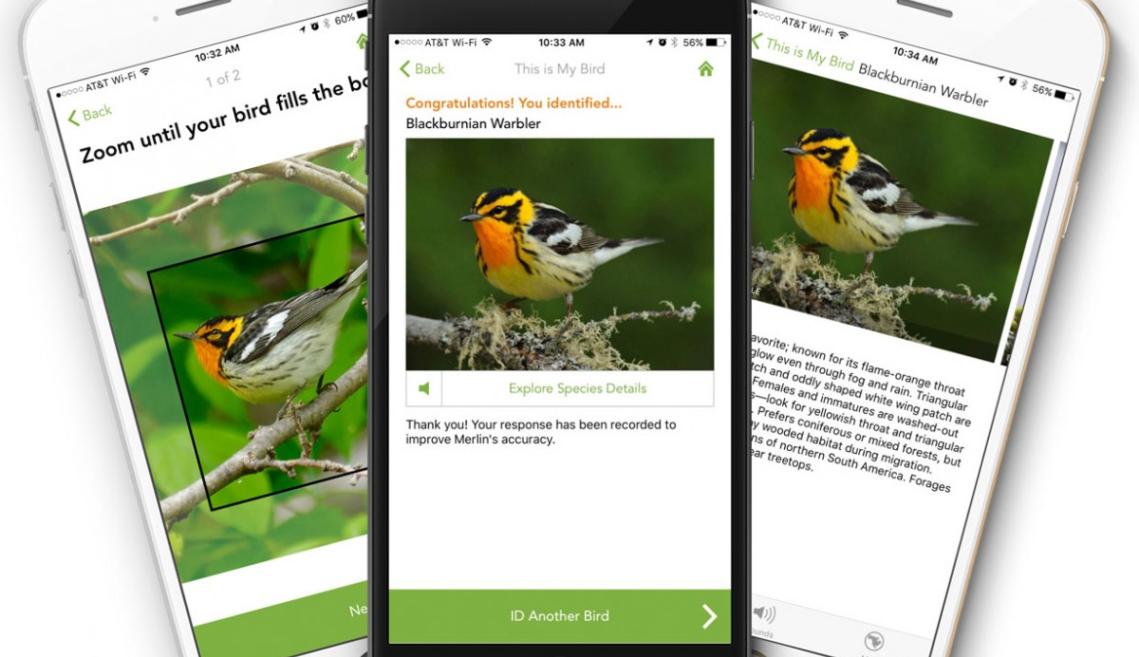
The Cornell Lab of Ornithology has the solution: the free Merlin Bird ID app, designed to answer the simple question, “What’s that bird?”

“Merlin is really focused on helping people easily identify their first bird,” said Drew Weber, Merlin project coordinator at the Cornell Lab. “You just answer five simple questions about date and location, plus the bird’s size, color and behavior. Or you can ask Merlin to identify a bird in a photo. In either case, Merlin lists the likely birds based on what’s been reported in your area at that time.”

Developed using artificial intelligence techniques and the millions of bird images archived in Cornell Lab’s Macaulay Library, Merlin Bird ID has learned to identify thousands of birds from photographs.
Merlin’s wizardry is powered also by the Cornell Lab’s eBird database – a citizen science project with millions of observations of birds reported by people all over the world. These observations help Merlin tell users which species to expect nearby, no matter their location.

Merlin includes more than 6,000 birds across the Americas, Europe, Asia and Australia.

The Merlin Bird ID app is available for free for iOS and Android devices and can be downloaded from Merlin.AllAboutBirds.org.

– Pat Leonard

This article also appeared in the Cornell Chronicle.

Keep Exploring

a woman holds a sheep in a show stance

Field Note

Jessica Waltemyer, New York State small ruminant extension specialist with Cornell PRO-LIVESTOCK, likes to joke that animals rule her life. “Personally and professionally, it’s animals all the time,” she said. “There’s no part of my life that...
  • Cornell Cooperative Extension
  • PRO-LIVESTOCK
  • Animal Science
On campus, students and researchers prepare to deploy the “Cornell Flux Chamber” in Colombia’s mangrove ecosystems, capturing methane emissions in a dynamic tidal landscape.

News

A student-built methane sensor device is empowering researchers and indigenous communities to protect and restore mangrove forests in Colombia.

  • Cornell Atkinson
  • Ecology and Evolutionary Biology
  • Biodiversity