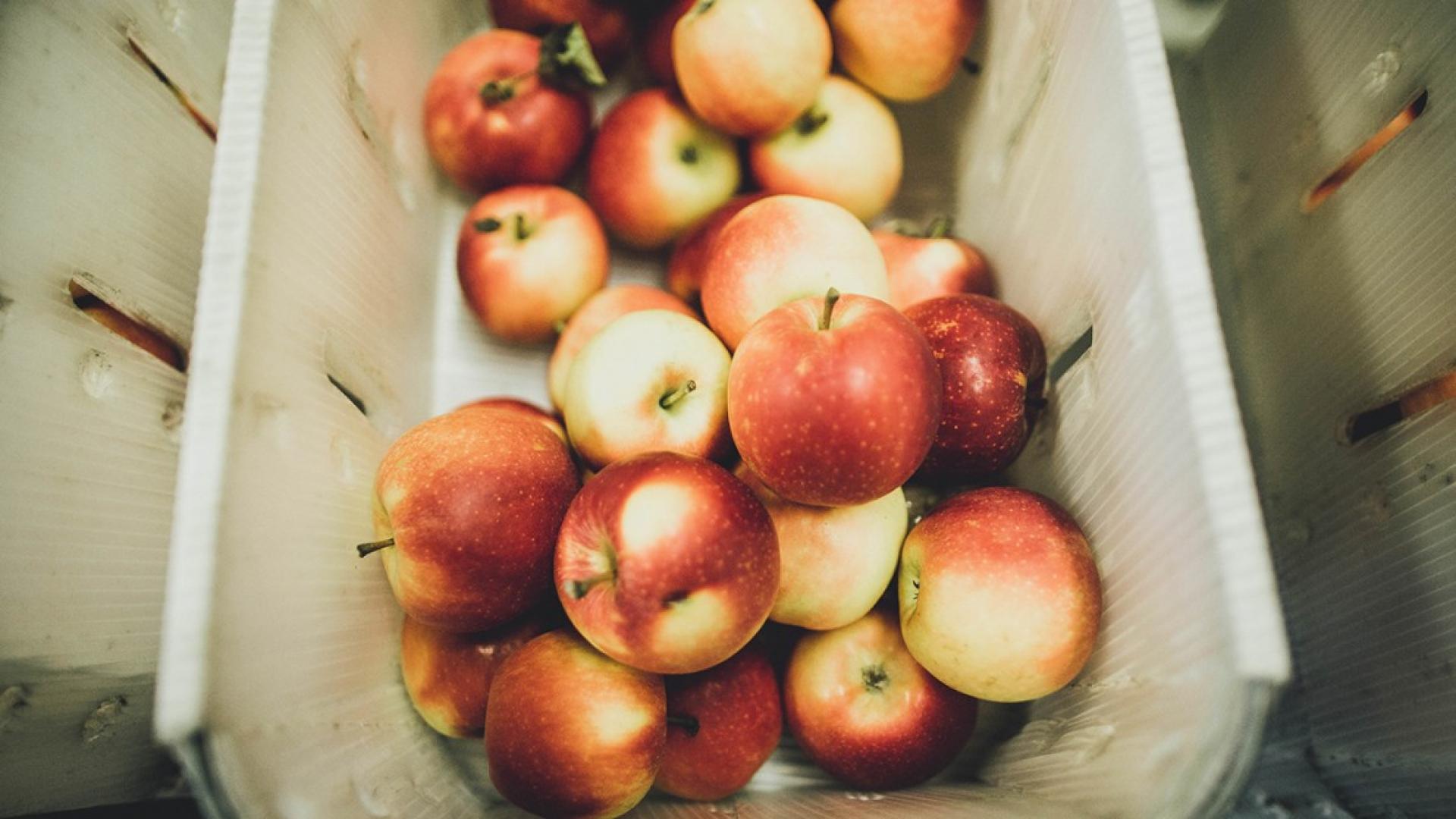
Throughout April, the orchards will be donating approximately 26,000 apples to two local school districts to supplement efforts to provide meals for students and families in need.
“We have been donating apples for years to local food banks, charity events and community gatherings. So giving back to the local community has always been a part of the orchards’ DNA,” said Eric Anderson, wholesale coordinator at Cornell Orchards. “We [already] give roughly 200 pounds of apples every week to the Friendship Donations Network.”
The newest project began when Anderson started talking with colleague Cathy Crispell, an Orchards technician, about an article that described the great need for schools to continue providing meals to local children during the COVID-19 shutdown. “During that conversation, we knew we had to try and help our local schools,” Anderson said.
Glenn Evans, director of operations for Cornell Orchards, quickly gave Anderson and Crispell the green light to reach out.
“Given this latest challenge, we were looking for more ways to use our resources to benefit the community,” he said. “Everyone on our team really rose to the occasion.”
Crispell reached out to Dryden Central Schools, where her daughter works, and Anderson took the lead on reaching out to the Ithaca City School District (ICSD). They quickly learned the needs were “truly quite staggering.”
ICSD has been making 2,500 meals a day to deliver directly to students’ homes. Dryden Central Schools has been producing about 175 boxes of meals every 10 days, each of which can feed a family of four until the next box arrives.
Anderson brought the first load of apples to the schools on March 30.
“We delivered Empire and Test Variety ‘B,’ which are both popular varieties from the Cornell apple breeding program,” he said. “They unloaded the bins of apples with a forklift, allowing us to maintain proper social distancing.”
“We really appreciate the donation of the apples,” said Beth Krause, director of ICSD’s Child Nutrition Program. “Cornell apples have been part of a delicious lunch given to ICSD students. We are distributing over 1,000 breakfasts and 1,600 lunches daily via school bus to about 700 homes.”
Anderson said that the orchards are “committed to delivering 11,200 pounds of apples over the next month, with weekly deliveries.”
The apples are carefully stored in coolers on Cornell’s Ithaca campus, to maximize long-term freshness and fruit quality.
“Typically, we would be selling the apples in the greater Cornell community, Cornell Dining, offices, sororities, fraternities and campus events,” Anderson said. “We had the inventory to help fill the need in the community, so I don’t see how we couldn’t help.”
Jim Catalano is a freelance writer for the College of Agriculture and Life Sciences.
Header Image: Photo by Cornell University File Photo