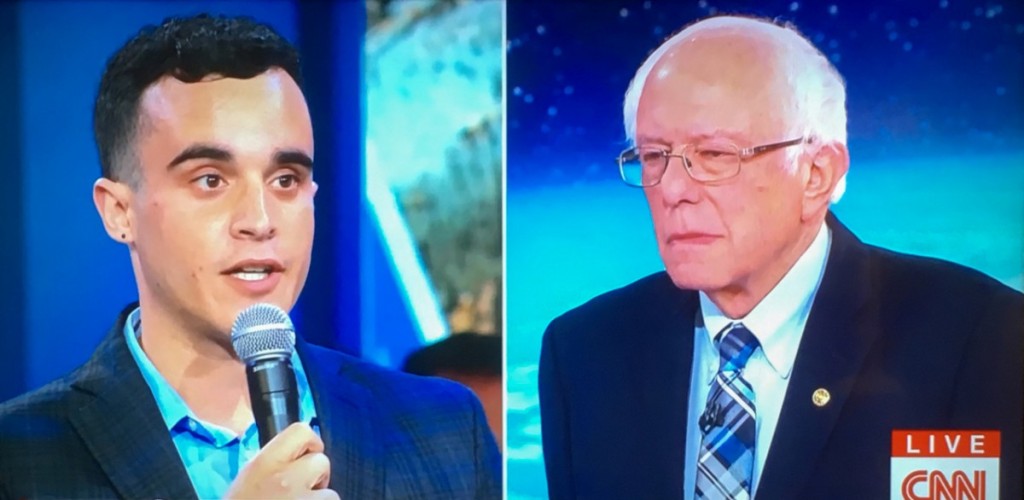
Marc Alessi ’18, a master’s degree student in atmospheric sciences, challenged Bernie Sanders on his position that dismisses nuclear energy technology.
“We’ve got a heck of a lot of nuclear waste, which … will stay around this planet for many, many, many thousands of years,” Sanders answered. “We don’t know how to get rid of it right now … I think that it is safer and more cost-effective to move to sustainable energies like wind, solar and geothermal – and not nuclear.”
Later in the town hall, Colin Evans, doctoral student in atmospheric sciences, asked former Texas congressman Beto O’Rourke about his understanding of global warming. O’Rourke replied that he’d recently read “The Uninhabitable Earth” by David Wallace-Wells, a book that describes the consequences of humanity’s climate inaction.
“We will not be able to live in the places that we call home today,” he said. “There will be a fierce competition for resources on this planet. Wars that will be precipitated by climate change – like [the war in] Syria – will pale in comparison to the wars that we [will] see in the future.
“If you think that apprehending 400,000 [people] at the U.S.- Mexican border last year was a big number,” O’Rourke said, “wait until some parts of the Western Hemisphere can no longer support human life. Because that’s exactly where we’re headed.”