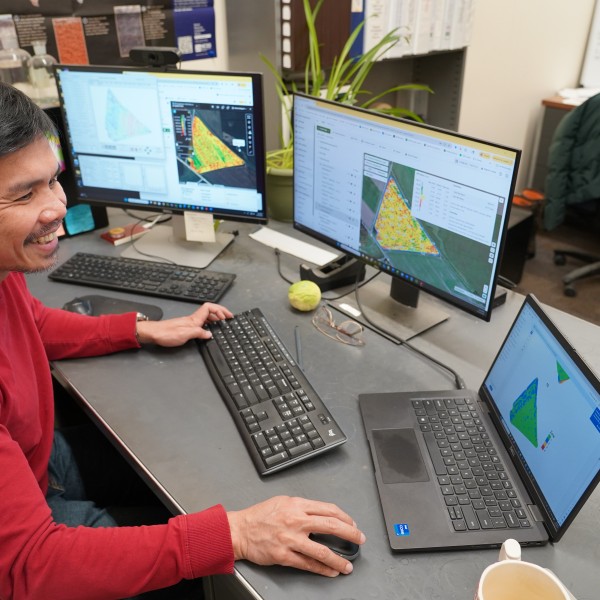
The White House has recognized four Cornell faculty members – Thomas Hartman, Jenny Kao-Kniffin, Kin Fai Mak and Rebecca Slayton – with prestigious 2019 Presidential Early Career Awards for Scientists and Engineers (PECASE). The awards were announced July 2.
The award is the highest honor bestowed by the federal government to scientific and engineering professionals who are in first stages of their independent research careers and who show exceptional promise for leadership.
Established 23 years ago during President Bill Clinton’s administration, the awards acknowledge the advancement of science, technology, engineering and mathematics (STEM) education; and community service, as demonstrated by scientific leadership, public education and outreach. The White House Office of Science and Technology Policy coordinates the PECASE with participating federal departments and agencies.
The Cornell award recipients:
- Jenny Kao-Kniffin, associate professor of horticulture in the College of Agriculture and Life Sciences, was awarded through the U.S. Department of Agriculture for her work in soil microbial ecology. Her research focuses on the bacteria and fungi found in the root zone of soils, known as the rhizosphere, and how they impact ecosystem nutrient cycling and the growth of plants. Many of these underground interactions can be isolated to better understand their potential for agriculture and land management, she said.
- Thomas Hartman, assistant professor of physics in the College of Arts and Sciences, was awarded through the U.S. Department of Energy for his work in reconciling quantum mechanics and relativity by examining “emergent gravity.” He is developing new ways to analyze quantum theories, which can be applied to the dynamics of black holes and other gravitating systems. This research could lead to significant steps toward resolving questions in quantum gravity – including string theory, the connection between gravity and thermodynamics, and Stephen Hawking’s black hole information paradox.
- Kin Fai Mak, associate professor of physics, was awarded through the U.S. Department of Defense, for his work exploring new physical phenomena in atomically thin materials. His Cornell group studies a range of materials – semiconductors, superconductors and magnets – that they stack to create electronics and opto-mechanical devices. To explore new phenomena, his lab has created new imaging techniques for the research. “Our ultimate goal is to push the limit on what can be seen and done in this two-dimensional world,” he said.
- Rebecca Slayton, associate professor in science and technology studies in Arts and Sciences, was awarded through the National Science Foundation for research examining cybersecurity expertise for critical infrastructure, such as the electric-power grid. Her research examines how expert knowledge and practices become authoritative, not only within individual organizations and workplaces, but also in the global context of international peace and conflict.