Nearly two in three U.S. college students reported feeling “overwhelming anxiety” in the past year, according to a 2018 report from the American College Health Association.
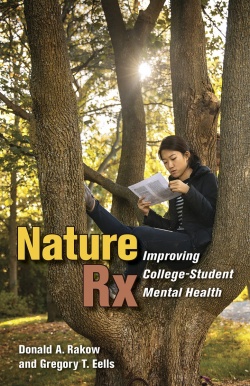
Nature Rx
While there’s no simple solution, copious scientific evidence backs up the notion that even short, semi-regular exposure to parks, gardens and other natural spaces can help with stress and depression.
A new book co-written by Don Rakow, associate professor in the School of Integrative Plant Science in the College of Agriculture and Life Sciences, explores ways schools can use those spaces to address the problem.
Rakow has teamed up with co-author Greg Eells, formerly the director of the university’s Counseling and Psychological Services, to write “Nature Rx: Improving College-Student Mental Health,” which came out May 15.
“It’s basically a how-to manual for college administrators, faculty and staff,” said Rakow, one of the forces behind the NatureRx@Cornell program. “The goal is to get a group of people at a school to come together to support a time-in-nature program for students.”
With its gorges, Botanic Garden and other natural areas, Cornell is well-known as one of the nation’s most beautiful campuses. But it’s far from unique in terms of natural beauty. “Every school,” Rakow said, “even urban campuses, has access to green spaces.”
Cornell serves as a case study in the book, along with three other schools. But Rakow said there’s no one-size-fits-all approach. “Each campus has to develop the sort of nature Rx program that best fits their school,” he said.