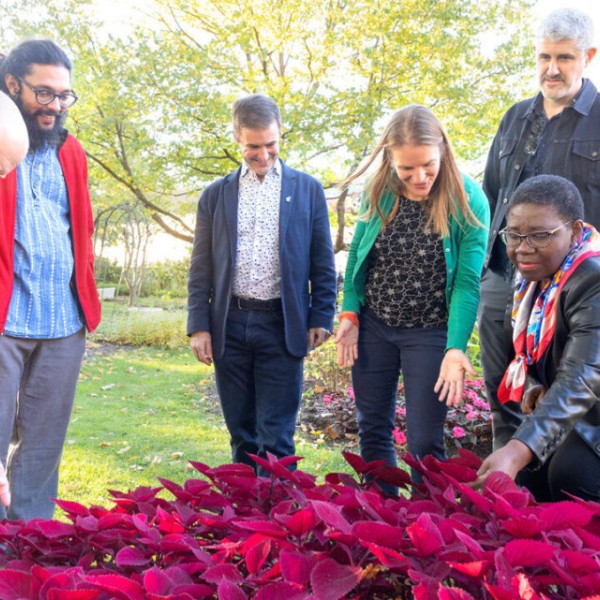
The College of Agriculture and Life Sciences cultivates knowledge and talent in order to grow agriculture in New York state and beyond. Graduate students studying at Cornell AgriTech in Geneva, New York, exemplify the way in which students are trained to lead the next wave of scientific breakthroughs.
Recently Elizabeth Cieniewicz shared some of the unique opportunities she had during her graduate work at Cornell AgriTech. Cieniewicz is a doctoral student in the lab of Marc Fuchs, a professor in the Plant Pathology and Plant-Microbe Biology (PPPMB) Section in the School of Integrative Plant Science. Cieniewicz has performed substantial research on grapevine red blotch virus and most recently published an article in Wine Business Monthly with recommendations for growers. Later this summer, Cieniewicz will join Clemson University as an assistant professor of plant pathology.
What drew you to the program at Cornell AgriTech?
My time as a summer scholar in 2012 helped me gain an appreciation for the program. I loved the community and impactful research being done here so much that, as I was applying to Ph.D. programs and making my decision, I knew that doing my research on the Geneva campus would be the chance of a lifetime. Cornell AgriTech afforded me the rare opportunity to help create solutions for growers while also conducting research that fulfills my scientific interests. That combination is truly unique to the PPPMB program here.
What’s the most rewarding part of researching grapevine red blotch virus (GRBV) for the grape industry?
Being able to directly interact with grape growers and extension associates in the field has been the most rewarding element of this project. The grape industry is extremely supportive of research that helps them overcome challenges and excel. Seeing our research translate into management recommendations has been exciting because I know these recommendations will help growers long term.
What is the most exciting thing you’ve discovered through your research?
The most exciting thing I have discovered through my research is that the GRBV spread in California vineyards is associated with the relative abundance of the insect vector. This was an important discovery because once a vine is infected with a virus, it won’t be cured. Understanding how GRBV is spreading in vineyards can help us target management practices that prevent spread from occurring.
How does your research impact NYS growers?
GRBV is found throughout the country, including in New York grapes. In particular, the red blotch situation seems to be much more problematic on the West Coast where it is spreading in vineyards and is also widespread in wild grapevines. In New York and the East Coast, there is currently no evidence of secondary spread of GRBV by insect vectors. While this vector is not prevalent in vineyards in New York now, it certainly could be in the future. GRBV research highlights the importance of planting vines only from virus-tested nursery stocks as well as frequent scouting of vineyards for virus symptoms.
How do you think your experience at Cornell AgriTech will help you in your future career?
I’m going to take so much of what I’ve learned in Marc Fuchs’ lab with me as I start my career and my own lab. Most importantly I’ve learned that research, teaching, outreach and mentorship should all be intertwined. Cornell AgriTech is a really special place because everyone is working in tandem to make a difference through their research. Faculty members work across disciplines to answer important scientific agricultural questions and the impacts of this multidisciplinary approach are evident. My time at Cornell AgriTech has given me the fuel I need to make a difference as a scientist and to teach others to do the same.