

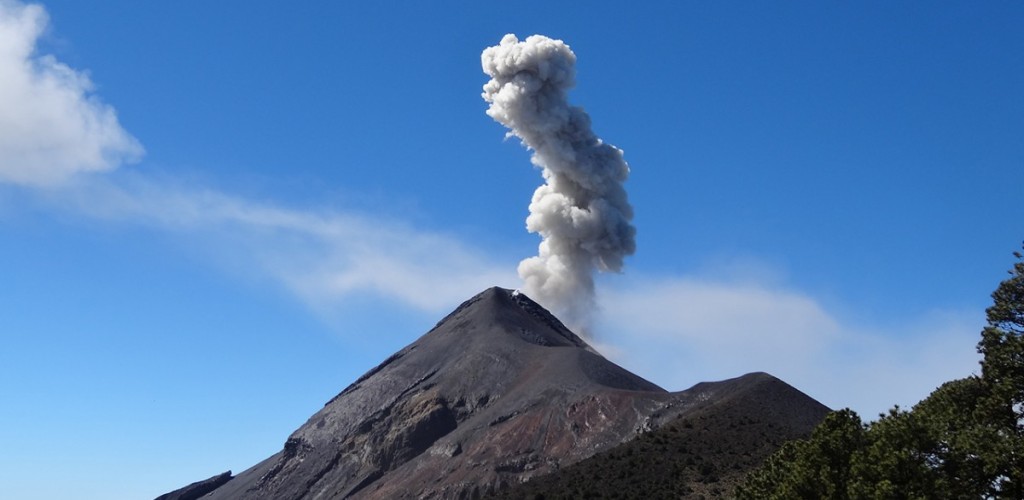
On Nov. 13, 1985, the Nevado del Ruiz volcano in the Andes – about 80 miles west of Bogota, Colombia – erupted, sending a pyroclastic flow down its mountainside.
The heat melted the snow at an elevation of more than 17,000 feet, and volcanic ash muddied the resulting water – called lahar – that rushed into the nearby town of Amero. More than 23,000 people died.
“This volcano killed over 70 percent of the town’s population. They were unprepared for the eruption,” said Kevin Reath, a Cornell postdoctoral researcher.
Reath’s work aims to prevent that from happening again. He has merged 17 years of satellite data on volcanoes with ground-based detail to form a model for state-of-the-art volcanic eruption prediction.
Reath’s paper, “Thermal, Deformation, and Degassing Remote Sensing Time Series (CE 2000–2017) at the 47 Most-Active Volcanoes in Latin America: Implications for Volcanic Systems,” was published in the Journal of Geophysical Research: Solid Earth (American Geophysical Union) in February.
“Volcanoes are hazardous to local and global populations, but only a fraction of volcanoes are continuously monitored by ground‐based sensors,” Reath said.
In South America, volcanoes lace the Ring of Fire around the Pacific Ocean. More than 60 percent of Holocene-era volcanoes in Latin America are unmonitored by ground-based sensors, and those with ground sensors still have gaps that satellites can fill, Reath said.
“We are compiling remote sensing data that has been underutilized,” he said.
The model aggregates three types of critical information: thermal data, such as volcanic hot spots and how they change over time; degassing data, which examines the presence of sulfur dioxide; and deformation data, accounting for inflation and deflation of magma reservoirs – pockets of lava inside the Earth.
“These data types have never really been intercompared in such an extensive database,” said Reath, who hopes to extract a more-robust understanding of volcanic processes.
But his work is not all volcanic eruptions. With over 17 years of satellite data, the scientists can find value in observing quiet among the volcanoes. “When we can see the volcano calm and then see the volcano when it is erupting, we can observe what’s happening leading to eruption. We can get a comprehensive picture of a volcanic behavior,” he said.
“Volcanoes have personalities,” Reath said. “Sometimes they have multiple personalities. Volcanoes can behave differently from each other, and volcanic behavior – from the same volcano – can vary from eruption to eruption. It helps geologists to understand what to look for before an eruption. We’re looking for typical volcanic background behavior and pre-eruptive behavior.”
Joining Reath on the paper are: Matthew Pritchard, Cornell professor, earth and atmospheric sciences; Francisco Delgado, Ph.D. ’18; Samantha Moruzzi ’20 and Allison Alcott ’18; and Scott Henderson, Ph.D. ’15, former Cornell postdoctoral researcher. This work was supported by NASA; the European Space Agency; and the Volcano Remote Sensing Working Group, John Wesley Powell Center for Analysis and Synthesis, U.S. Geological Survey.


