

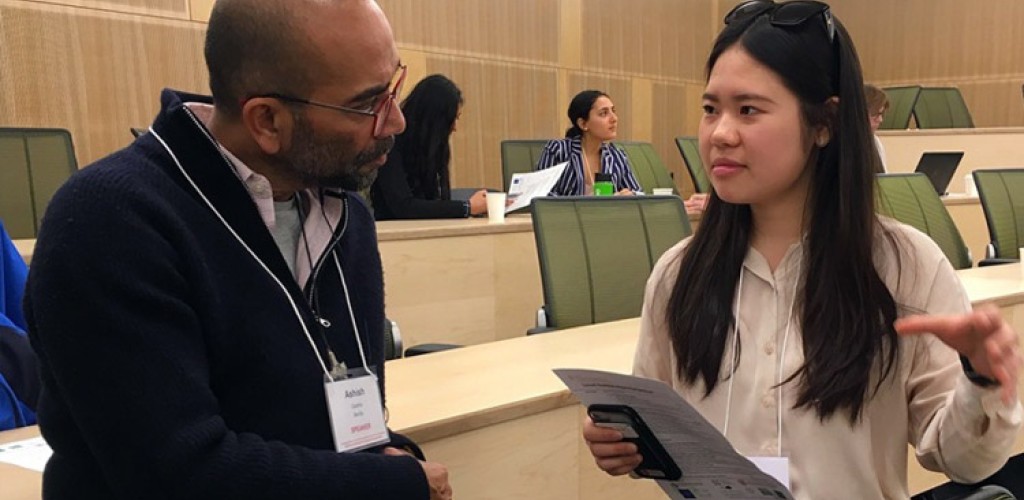
At the early morning Cornell Business Impact Symposium on March 9, keynote speaker Ashish Gadnis, CEO of BanQu, woke everyone up: He explained blockchain.
Gadnis described a business pathway to positive social impact that could help 100 million people around the world rise from poverty, reduce gender inequality, vanquish black markets and bring light to shadow economies.
“Blockchain,” he said, “is a pathway to social justice and to make the world a better place.”
The symposium drew student leaders and professionals to explore how business addresses environmental and socio-economic issues – keys to environmental success. The daylong conference at the Breazzano Family Center for Business Education featured sessions on building climate resilience in communities; food sustainability certifications; ecotourism; sustainable technology; and how to transform the fashion, textile and clothing manufacturing industry from a polluter into something sustainable.
BanQu (pronounced bank-cue) is the world’s first non-cryptocurrency blockchain global-supply platform; it serves brands, organizations and governments. Gadnis said that about 2.7 billion people – more than a third of the world’s population – lack “economic identity,” such as simply holding a bank account. Lacking a credit history or digital bona fides creates a secluded economy for the poor.
Impoverished smallholder farmers produce crops and supply large companies with raw materials that ultimately land with the world’s consumers. Middlemen acquire the materials, and farmers are easily defrauded with partial payments. The farmers – a majority of whom are women – remain poor.
With blockchain, each point along the material’s distribution trail includes full information on the product and payment information. Gadnis showed how his blockchain software creates a “distributed ledger” – which cannot be destroyed or manipulated – between the farmers, the middlemen and the company.
The corporate entity knows exactly how much the farmer and the middlemen are being paid, ensuring that farmers get paid promptly and correctly, and ascend from poverty.
“In terms of sustainability, blockchain has the potential to increase transparency and supply chain integrity for businesses,” said Mark Milstein, clinical professor of management and director of the Center for Sustainable Global Enterprise at the Samuel Curtis Johnson Graduate School of Management, and an organizer of the symposium.
The direct impact of this blockchain is system transparency, said Tanuj Ahuja ’19, a Cornell Tech information science master’s student. “Now everyone knows where the transactions are happening. You can get rid of shadow economy. It becomes easier for everyone, including corporate stakeholders.”
Daniella Zandi ’19 said blockchain can eliminate headaches, such as “making sure that people get what is due to them.”


