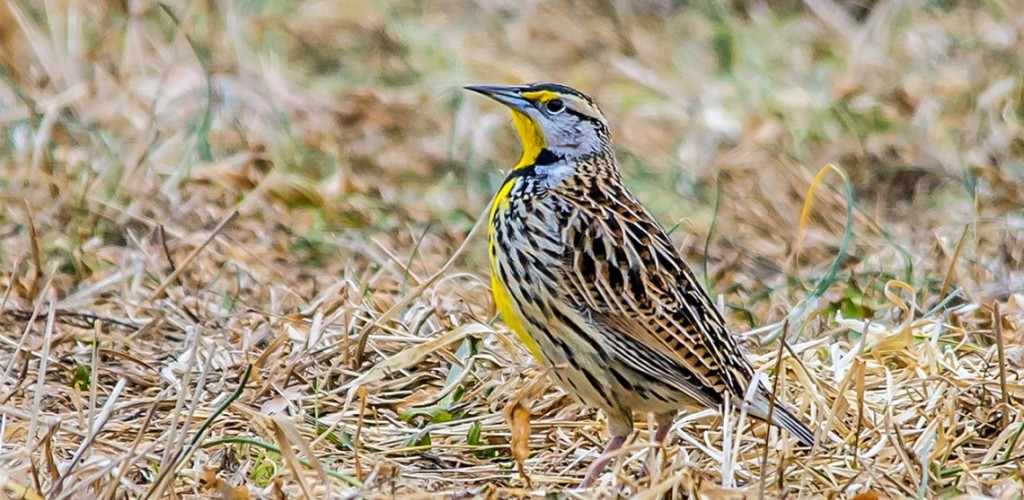
Under future climate scenarios, changing winds may make it harder for North American birds to migrate south in the autumn but easier for them to come north in the spring.
Researchers from the Cornell Lab of Ornithology came to this conclusion using data from 143 weather radar stations to estimate the altitude, density and direction birds took during spring and autumn migrations over several years. They also extracted wind data from 28 climate-change projections in the most recent report from the Intergovernmental Panel on Climate Change. Their findings were published Dec. 9 in Global Change Biology.
“We combined these data to estimate how wind assistance is expected to change during this century under global climate change,” said lead author Frank La Sorte, a Cornell Lab of Ornithology scientist. “This matters for migratory birds because they use more energy flying into headwinds. But they get a nice boost from tailwinds so they can conserve energy during flight.”
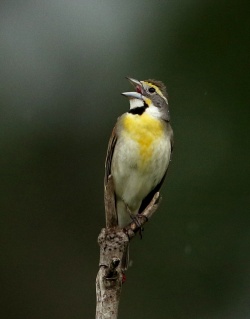
Dickcissel
La Sorte and co-authors predict winds from the south will become stronger by the end of the century during spring and fall migration periods. Winds from the west may be stronger during spring migration and slightly weaker during the fall. Westerly winds are much more variable overall and harder to predict because they are tied to erratic fluctuations in the high altitude jet stream. Wind changes will be most pronounced in the central and eastern portions of the continent.
With an assist from stronger tailwinds during spring migration, birds would likely arrive at their northern breeding grounds in better condition and with better odds of survival. Their fall migration flights into stronger headwinds would drain more energy. If headwinds are too strong, birds may choose not to fly at all on a particular night, throwing off the timing of their migrations.
“The thing to remember about these projected wind changes is that they will not occur in isolation,” La Sorte said. “There will be other global change factors for birds to contend with, including changes in temperatures, rainfall and land cover.”
Some birds may be able to adapt because the expected wind changes are likely to happen gradually. Studies also show migratory birds already adjust their migration strategy under current conditions, altering their headings to compensate for winds that push them from their intended flight path.
“The bottom line is that some climate change effects could be negative for migratory birds, and some might even be positive, as least for a while,” said La Sorte. “There’s an awful lot of uncertainty because both climate and migration are complex systems that can intersect in many different ways.”
Support for this study came from the Wolf Creek Charitable Foundation, Amazon Web Services and the National Science Foundation.