

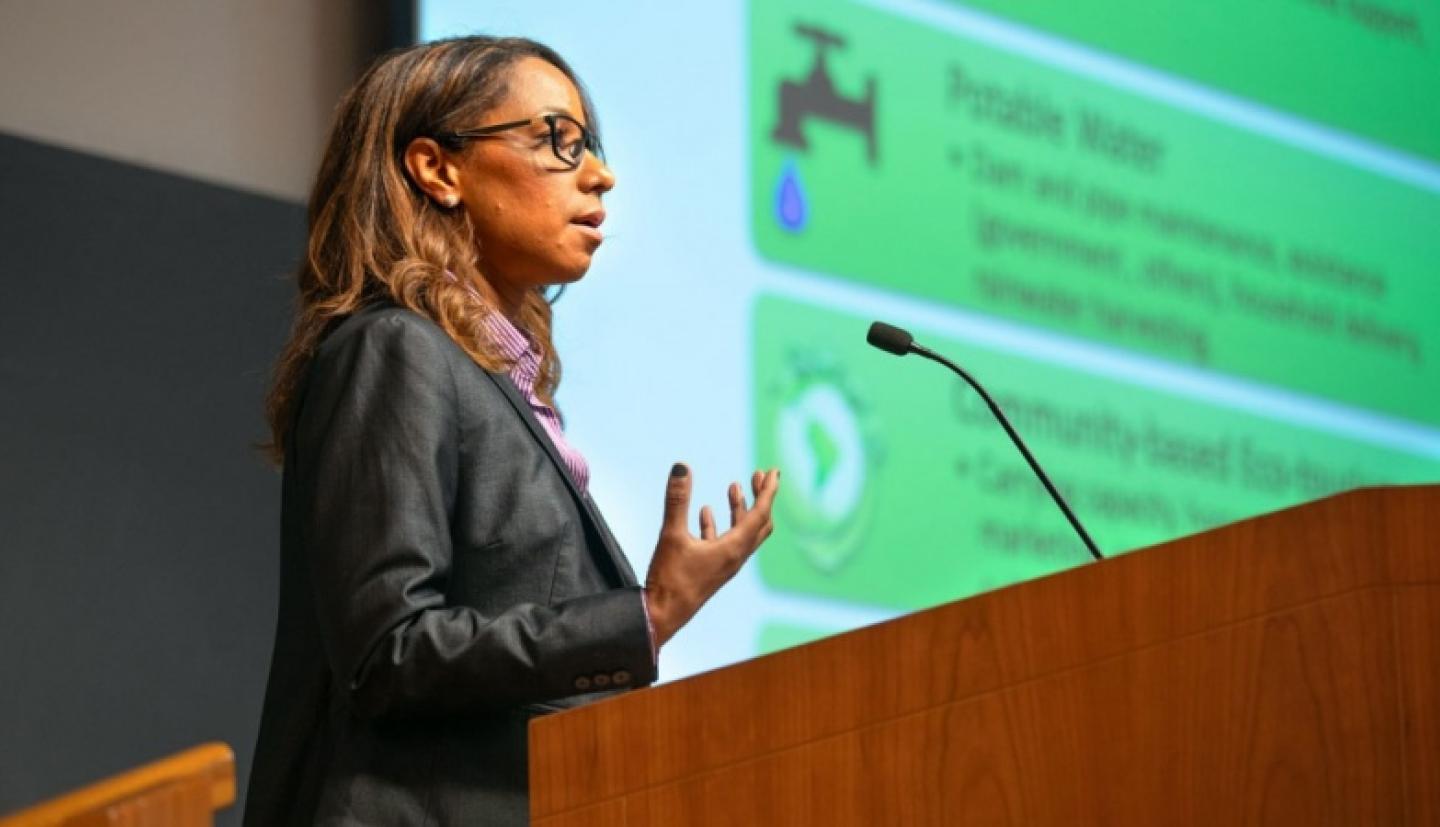
In this era of rising atmospheric temperatures, Shorna Allred worries about preserving the world’s indigenous societies.
“Indigenous people around the world are incredibly important when we think – in terms of climate change and impact – about what is happening to our planet,” said Allred, associate professor of natural resources, in her Dec. 6 keynote address at Cornell’s 2018 Sustainability Leadership Summit. Each year leaders across campus gather to discuss and find ways to make the campus sustainable.
Allred, who is also associate director of Cornell’s Center for Conservation Social Sciences, discussed her work with indigenous populations and their vulnerability due to climate change
Indigenous territories hold 80 percent of the world’s biodiversity and cover 24 percent of the Earth’s surface, she said. “But when you look at economic indicators, indigenous people are 5 percent of the world’s population and represent 15 percent of the world’s poor,” said Allred, who received Cornell’s third annual Engaged Scholar Prize last April.
For five years, Allred has worked in partnership with Cornell’s Public Service Center and the Southeast Asia Program to create the Global Citizenship and Sustainability (GCS) Program, which offers students opportunities for community-based research.
Through the program, Cornell students have worked in Long Lamai, a village in northern Sarawak in Malaysian Borneo – south of Vietnam across the South China Sea – for the past three years. The village is home to the Penan, a formerly nomadic people who have now settled; there are approximately 600 Penan in 114 households.
The GCS program has partnered with the Institute of Social Informatics and Technological Innovations at the Universiti Malaysia Sarawak to address Penan village needs.
The Penan wish to pursue indigenized development and exchange knowledge around the globe. Additionally, the students helped to work on issues of water supply, communication technologies, ecotourism and sustainable energy options to enhance the current micro hydro-dam to make electricity.
Doctoral student Mike Dunaway ’19, a member of the Choctaw Nation of Oklahoma, visited the Penan village and spoke at the Sustainability Summit. “Going to Malaysia was important because I was interacting with another indigenous community,” he said. “I was able to talk to them about their issues, their concerns and share about my own indigenous community … share experiences from half a world away.”
Paraphrasing the 18th-century essayist Samuel Johnson, Dunaway said that we travel to regulate our imagination with reality. “Instead of thinking of how the world might be, we can see it as it truly is,” he said. “That’s the power of going places and doing research like this.”
Dunaway worked on electrification issues during his trip. “Climate change impact for indigenous communities is going to be far worse. Culture is lost. Language is lost,” he said. “These are the things that make indigenous people indigenous. Sustainability is not a luxury that needs to happen someday. It needs to happen now.”
The summit was hosted by the President’s Sustainable Campus Committee and organized by the Campus Sustainability Office.


