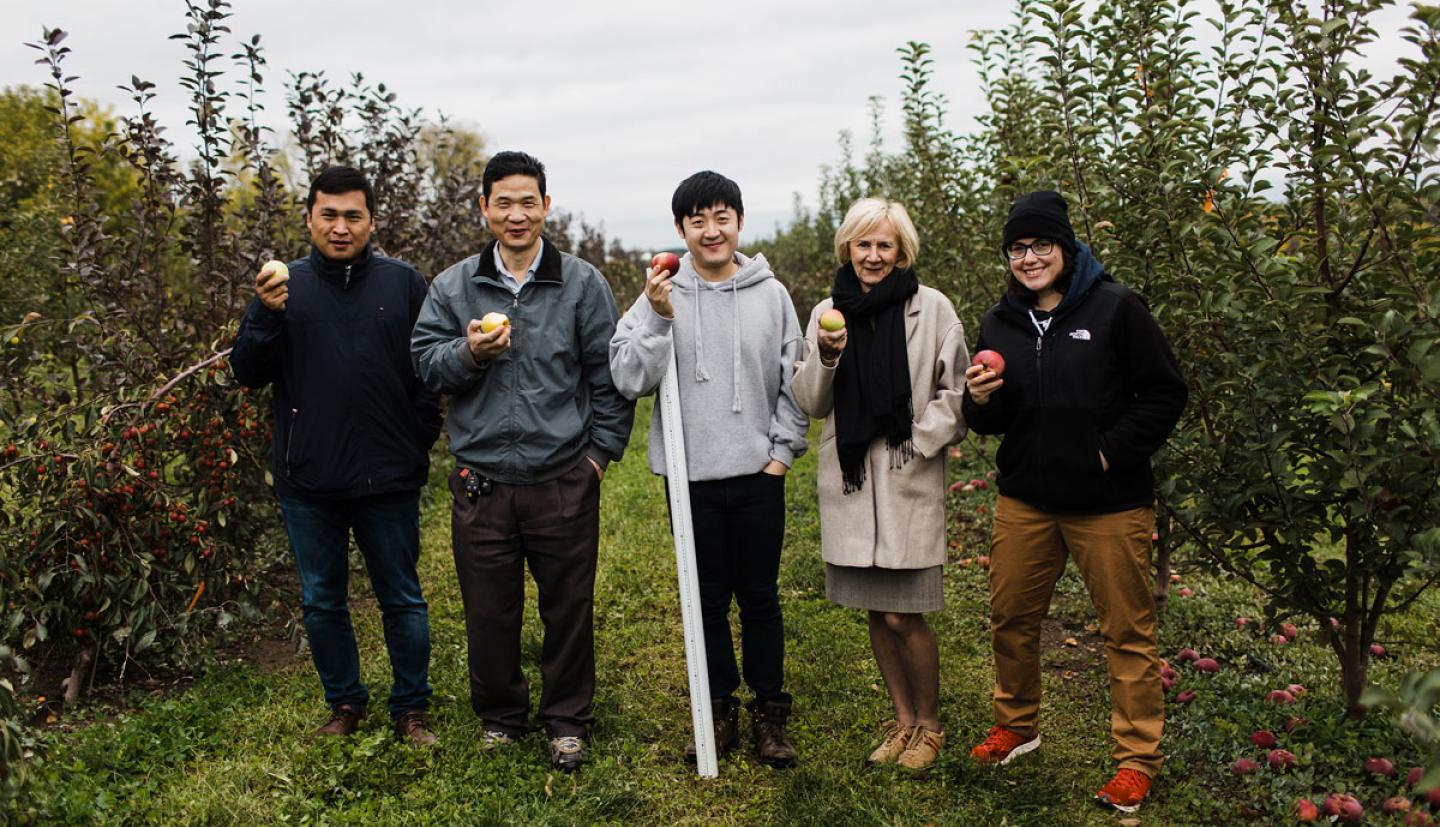
Graduate students based at Cornell AgriTech are reimagining the future of food and agriculture systems as they work to improve the health of the people, environment and economy of New York state and beyond. Our students in the College of Agriculture and Life Sciences are positioned to perform purpose-driven science as they lead the next wave of breakthroughs.
Laura Dougherty, a fourth-year doctoral student in the field of horticulture, is researching apple tree genomics under the guidance of Kenong Xu, professor in the Horticulture Section of the School of Integrative Plant Science, to benefit the commercial apple industry in New York.
How did you discover the program at Cornell AgriTech?
As a native of Geneva, New York I always knew about the campus here. One summer as an undergraduate student at Keuka College, I had the opportunity to be a summer scholar in the plant pathology department. That was my first one-on-one experience at Cornell AgriTech. My eyes were opened by the amazing research performed here. I knew I wanted to be at Cornell AgriTech in the future.
What do you hope your research at Cornell AgriTech will accomplish?
My research deals with identifying genes controlling apple fruit quality and tree architecture. I hope that my research can help breeders make new exciting apples in the future and also help growers. Understanding why trees grow a certain way can be useful for mechanization in the future.
What inspires you as a doctoral student in the College of Agriculture and Life Sciences?
There is something very special about making discoveries and learning new things. I am always excited to see how my experiments turn out. Every day brings new challenges and successes.
What is your most memorable student experience?
I have really enjoyed collecting fruit from fields during apple harvest season. The apple germplasm in Geneva is mesmerizing with its many different kinds of apples. In Professor Xu’s research fields, I also like to observe the multitude of trees. I started most of the trees from seeds and to take care of them and watch them grow is really rewarding.