

Scientists have shown that a bird found in Pennsylvania is the offspring of a hybrid warbler mother and a warbler father from an entirely different genus– a combination never before recorded. The finding of the three-species hybrid bird was published Nov. in Biology Letters.
“It’s extremely rare,” said lead author David Toews, postdoctoral associate at Cornell Lab of Ornithology. “The female is a golden-winged/blue-winged warbler hybrid– also called a Brewster’s warbler. She then mated with a chestnut-sided warbler and successfully reproduced.”
Video by a bird watcher and eBird user Lowell Burket of Roaring Spring, Pennsylvania, recorded a male bird that sang like a chestnut-sided warbler but had some of the physical characteristics of blue-winged and golden-winged warblers.

Hybrid Banded Warbler
The key to identifying the triple-hybrid’s parents came from genetic analyses.
“We looked at the genes that code for different warbler colors,” Toews explained. “This way we could re-create what the hybrid’s mother would have looked like – the avian equivalent of a detective’s facial composite, but generated from genes. We confirmed that the mother would have looked like a Brewster’s warbler and the father was a chestnut-sided warbler.”

Golden-winged/Blue-winged Warbler Hybrid
Hybridization is common among golden-winged and blue-winged warblers, leading to concern that the golden-winged will be hybridized out of existence. But hybridization has never been recorded between these species and chestnut-sided Warblers. This rare hybridization event may also occur more often in the declining warbler populations of Appalachia, because there is a smaller pool of mates from which to choose.
“That this hybridization occurred within a population of golden-winged warblers in significant decline suggests that females may be making the best of a bad situation,” Toews said. “It also tells us that wood-warblers in general have remained genetically compatible long after they evolved major differences in appearance.”
Lowell Burket
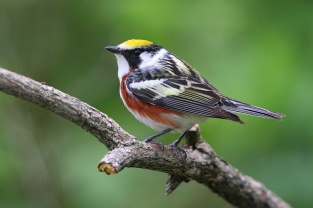
Chestnut Sided Warbler
Will the bird’s mixed ancestry confuse potential mates and make him a pariah or will he be able to find a mate and successfully produce offspring? Scientists are going to keep an eye on this location to see what the future may hold for this very rare bird.


