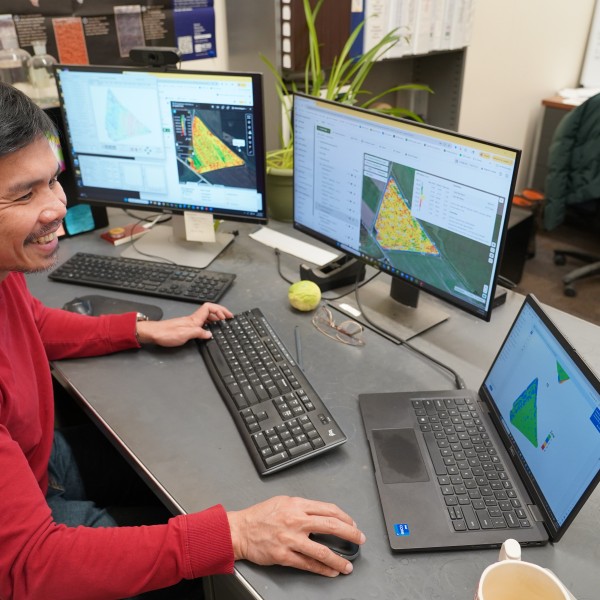
Margaret Frank, assistant professor, Plant Biology Section, SIPS
Academic focus: I study the genetics and genomics of plant grafting
Previous positions: Lab manager/technician for the Arnold Arboretum at Harvard University; Ph.D. student, Cornell University; NSF National Plant Genome Initiative Postdoctoral Fellow at the Donald Danforth Plant Science Center
Academic background: B.A., biology, Barnard College, 2007; Ph.D., plant biology, Cornell, 2014
Last books read: Tuxedo Park and The Amazing Adventures of Kavalier and Clay.
What do you do when not working? You can find me outdoors, in a coffee shop, or on a plane (I really like to travel).
What gets you out of bed in the morning? That changes all the time. I'm most passionate about whatever problem is currently on my plate. One thing that I'm consistently excited about are the people who I work with to solve these problems. I really enjoy collaborating with other scientists, and working together to identify new ways to attack research questions.
Current research projects? I have two big projects that are focused on plant grafting. One project looks at the genetic mechanisms for graft compatibility between species, and the other project is centered on identifying graft transmissible signals that can be used for crop improvement. There are several other non-grafting related projects in the lab that are related to engineering plants for sustainable agriculture.
Current outreach/extension projects? I'm looking forward to working with the local tomato growers to identify rootstocks for improved crop production in upstate New York.
What are three adjectives people might use to describe you? Tomato lover, runner, terrible singer
Course you’re most looking forward to teaching? I'm really looking forward to teaching Plant Biodiversity and Evolution (BIOPL 2410). A lot of students take this course, which means that I have the opportunity to raise plant awareness and hopefully for some, a passion for plants, in a large slice of the undergraduate population at Cornell.
If you had unlimited grant funding, what major problem in your field would you want to solve? How do cells, tissues and organ systems communicate?
What most excites you about Cornell CALS? I'm excited to be a member of CALS' School of Integrative Plant Science. There are hundreds of plant experts in SIPS, which means that I'll be learning new things about Plant Science and developing new collaborations within CALS for my entire career.