

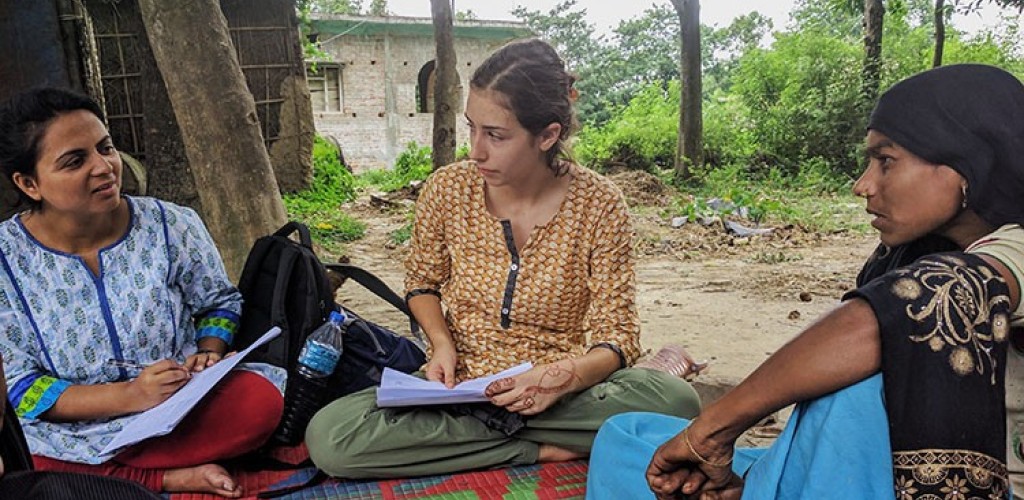
“Food security is complex. Unless you’re on the ground with the people battling it, you will never understand what it is like or the facets involved. So be a humble and curious sponge, learn a lot and have a blast.”
That was Isabella Culotta’s advice upon returning from the International Centre for Integration Mountain Development (ICIMOD) in Kathmandu, Nepal, where she worked as an intern helping women with a solar-powered irrigation project in 2017.
For that work and her exceptional achievement as a Borlaug-Ruan International intern, the first-year Cornell student received the 2018 Elaine Szymoniak Award at the 2018 World Food Prize Laureate Award Ceremony in Des Moines, Iowa, on Oct. 18.
“I am so honored to receive the Elaine Szymoniak Award,” said Culotta, who plans to major in international agriculture and rural development in International Programs in the College of Agriculture and Life Sciences. “I have immense gratitude for the World Food Prize community and all the farmers, scientists and development professionals who have taught me so much over the years.”
Culotta worked with ICIMOD to pilot gender empowerment evaluation techniques for the implementation of solar-powered irrigation pumps in the Saptari District of Nepal to irrigate rice paddies, vegetable and lentil fields. The ultimate goal was to increase women’s financial empowerment through the introduction of the pumps in Saptari. Culotta worked at the ICIMOD office in Kathmandu studying past evaluation methods, compiling literature and brainstorming ideas and statistical methods to assess impact. She traveled to Rajbiraj, Nepal, to pilot the survey and train interviewers to complete the evaluation with households that were already using the solar-powered pumps.
Culotta was selected for the Borlaug-Ruan International Internship after participating in the World Food Prize Global Youth Institute in 2016, which gathers high school students from around the world to discuss food security and policy with international experts.
“Bella does not shy away from hard work, as evidenced by her experience working abroad on a farm during her gap year,” said Francine Jasper, who manages the New York Youth Institute, (NYYI). Culotta credits her participation in the NYYI and the World Food Prize Global Youth Institute for motivating her to work on aspects of global food security.
“Learning about the world's numerous agricultural practices directly from their practitioners is incredibly important to whichever agriculture-related field one is pursuing. Before we can take it to the farmer, we must understand their wants and needs,” Culotta said.


