Lace up your walking shoes and head to Cornell’s new Sustainable Landscapes Trail, which will open with a ceremony Friday, Oct. 5, at 2 p.m., at the newly refurbished Peterson parking lot across from Stocking Hall and the Dairy Bar on Tower Road.
In lieu of a ribbon-cutting, officials will offer a celebratory “downpour” of water on the sustainable, permeable asphalt. Afterward, Nina Bassuk, professor of plant science, will lead a tour of the Sustainable Landscapes Trail.
Stretching from the Libe Slope Meadow to the Botanic Gardens’ Native Lawn, the trail features 20 stops that show how design, construction and the management of campus grounds can enhance and promote healthy landscape ecosystems.
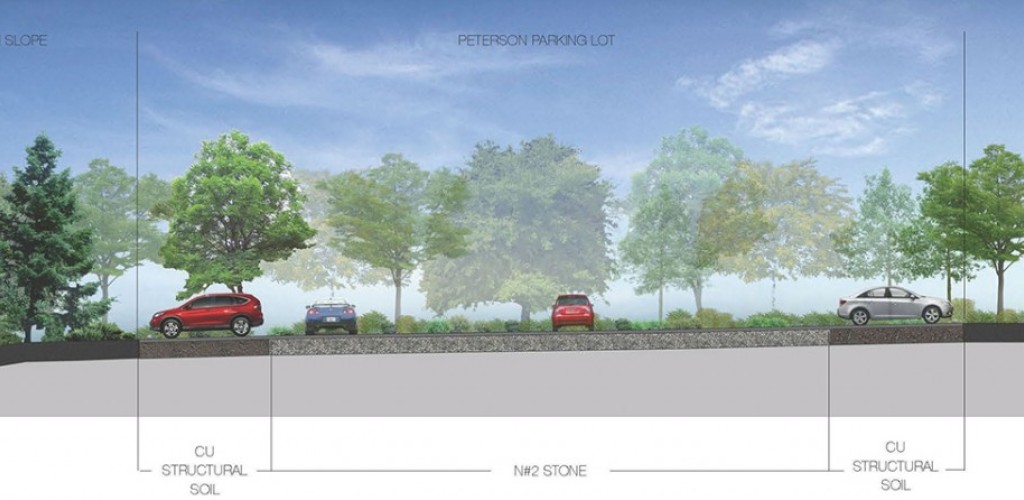
The Peterson green parking lot was constructed this summer as a state-of-the-art example of green infrastructure and is the latest project to join the trail. It was designed by landscape architecture students and Cornell stuff to demonstrate an alternative to traditional impervious parking lots and the resulting storm water runoff.
As a cause of water pollution, runoff from impervious roads and parking lots collect oil, sediment and other pollutants – and carries this material into waterways.
Green infrastructure practices will turn this parking lot into a natural landscape by capturing rainwater where it falls, filtering out pollutants and reducing large volumes of runoff, said David Cutter, Cornell’s campus landscape architect.

The Peterson lot’s porous pavement allows storm water to drain into a stone reservoir below the lot’s surface, while CU-Structural Soil along the lot’s central bioswale (a landscape element designed to remove pollution) allows the roots of bushes and trees to succeed under paved surfaces.
The parking lot is expected to be certified by both SITES, an initiative of the U.S. Green Building Council to certify sustainable land design and development, and by Parksmart, a rating system for green parking structures.
Other highlights of the trail include Fernow Hall’s rain garden and green roof; a green roof consists of a shallow layer of light-weight soil and plants that filter runoff. Fernow Hall’s rain garden diverts storm water from paved areas and roofs and channels it into the ground using a well-draining soil that helps to prevent polluted water from flowing directly to streams and lakes.
The trail also includes Mann Library’s entrance garden and green roof, the Ag Quad biodetention basins, which control pollution, and the Tower Road bioswale, which filters polluted water runoff with carefully selected plants growing in engineered soil and it provides a habitat for insects and pollinators.
The trail is a living laboratory for open spaces, natural areas and landscapes with unique sustainability features. On the trail, see the Rice Hall bioswale that undergraduate students built by using a technique called “scoop and dump” during a project in the “Urban Eden: Woody Plant Selection, Design and Landscape Establishment,” taught by Bassuk and Peter Trowbridge, professor of landscape architecture.
The Sustainable Landscapes Trail was developed by the Land Team of the President’s Sustainability Campus Committee. It fulfills a goal in Cornell’s Climate Action Plan, by demonstrating best practices in sustainable landscape planning, design and management, according to Sarah Brylinsky, Cornell’s sustainability communications manager.