

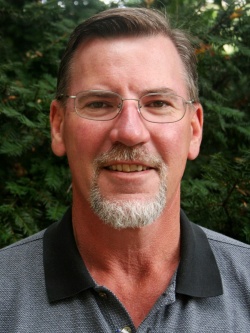
Bob Portmess, MPS ’08, was a mechanical engineer and telecommunications executive who just happened to be an avid golfer. In 2006, Portmess walked into the office of turf grass expert Frank Rossi, associate professor in the School of Integrative Plant Science, and said he wanted to switch careers. His goal: to work with people who produce the best golf playing surfaces in the world.
Two years later, Portmess received his Master of Professional Studies in agriculture and life sciences specializing in turfgrass management, synthesizing the practical knowledge that Rossi and colleague Jennifer Grant, now director of the New York State Integrated Pest Management (NYSIPM) Program, had amassed over seven years of experimental work to reduce the use of chemicals at Bethpage Golf Courses, a New York State Park.
Portmess, who died in 2016 at age 60, earned a posthumous Excellence in IPM Award from the NYSIPM in the College of Agriculture and Life Sciences Aug. 10 for his efforts to support and protect New York’s agricultural and urban communities.
Portmess developed an Integrated Pest Management Handbook of best practices for sustainable turf, informed in part by his engineering background. The handbook, since translated into Spanish, served as a resource for the Golf Course Superintendents Association of America’s seminar Portmess co-taught at several international golf shows. It continues to guide low-input management of New York’s 29 state park golf courses and golf courses around the country.
His passion for teaching was as consuming as his passion for golf. “Whether it was frequent light topdressing, root pruning, overseeding, better ways to aerify the soil, or careful use of water – Bob taught them all,” said Larry Specchio, superintendent at Chenango Valley State Park Golf Course.
Rose Harvey, commissioner of New York State Parks, said: “His legacy lives on in the sustainable management of our golf courses.”


