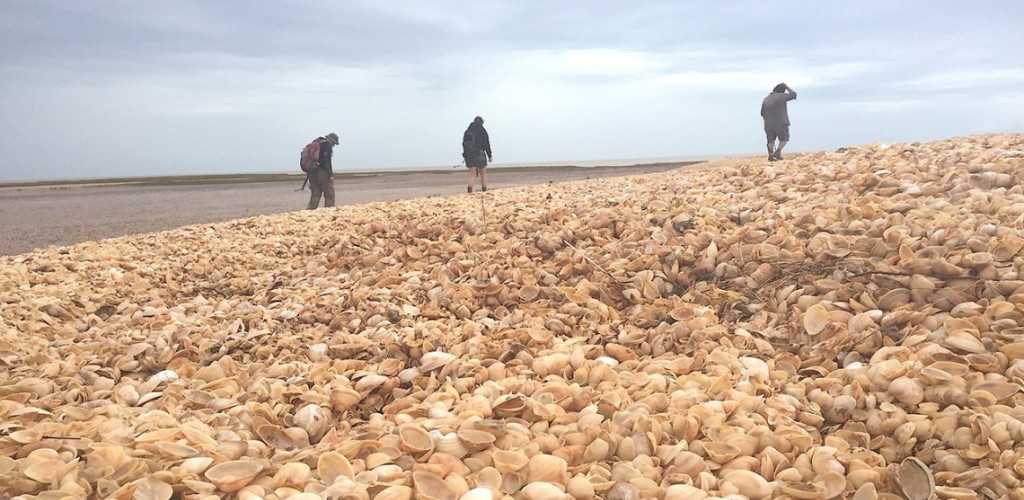
Dams along the Colorado River and its tributaries have caused profound environmental changes, such as disturbing the food web and driving species toward extinction. The evidence is clear, in spite of the thick mud at the river’s estuary in Mexico’s Gulf of California.
Cornell and Paleontological Research Institution (PRI) scientists dug into the estuary’s mudflats to learn how upstream dams affect downstream mollusks, examining centuries-old clam shells to seek clues on how the food chain may have been affected.
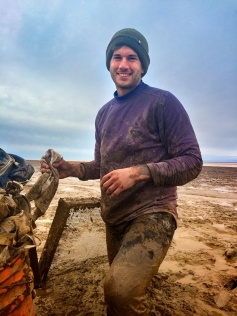
“Paleoecological data from the last several hundred years suggest damming and water diversions along the Colorado River have resulted in considerable habitat change at the estuary,” said Jansen Smith, Ph.D. ’18, a co-author of “Effects of Dams on Downstream Molluscan Predator-Prey Interactions in the Colorado River Estuary,” published in the Proceedings of the Royal Society B, May 30. The paper was co-authored with Greg Dietl, curator of Cenozoic invertebrates at PRI and an adjunct associate professor of earth and atmospheric sciences, and John Handley, a research associate at PRI and a scientist with the University of Rochester’s Goergen Institute for Data Science.
The population of the once-abundant, ecologically important clam, Mulinia modesta, has dropped by 94 percent over the last century, which in turn has caused populations of predators like moon snails to decline or switch to alternative prey, or both, said Smith.
“We’re learning how this predatory snail species interacts with its prey species,” said Smith. “In this type of system, snails play a big role, as they’re eating a variety of things and they can easily impact prey populations. We are looking to see what this means in terms of the food chain, so that we can understand how both predator and prey populations have responded to habitat change.
“We found that despite being able to switch to alternative prey, the moon snail population has likely also declined,” said Smith.
Smith said this kind of study – delving into the paleo history of the waterway – could be used to understand human impacts on modern environmental systems.
“There is huge demand for water and – in terms of water management – increasing stress on the river system for human needs, such as agriculture and potable water,” Smith explained. “The changes we’re seeing in the estuary – including declines in predator populations – are the kinds of environmental problems scientists might expect to see in other dammed river systems.”
Funding for this research was provided by the National Science Foundation, Cornell’s Atkinson Center for a Sustainable Future and the Geological Society of America.