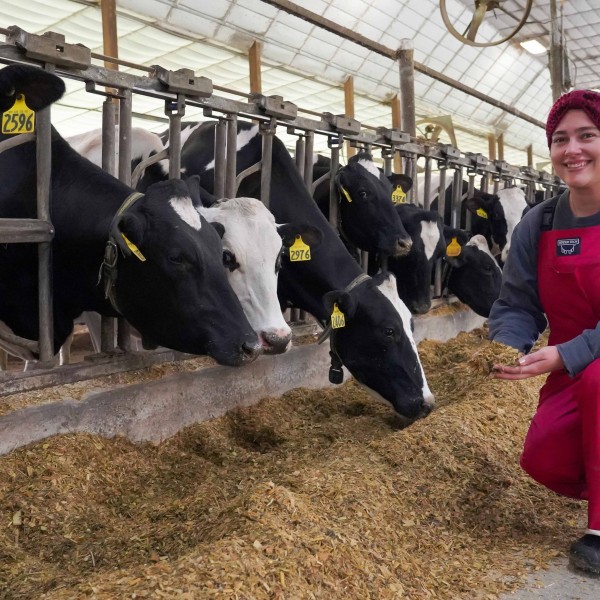
A project to improve pregnancy outcomes through dietary recommendations and prenatal supplementation and another to use choline technology to mitigate fatty liver disease in dairy cattle are two of nine projects awarded 2018-19 Center for Advanced Technology (CAT) grants.
CAT is housed in Cornell’s Institute of Biotechnology.
The one-year grants are given to faculty in life sciences fields – including biomedical engineering, agriculture, veterinary medicine, medicine and pharmacology – who partner with a New York state industry for biotechnology research and product development. In addition to novel biotechnology products, the partnerships also result in the creation of new jobs, revenues and startups.
The 2018-19 grants, which started July 1, total $401,000 in direct funds from NYSTAR, with an additional $545,000 in matching funds provided by industry partners.
“The diversity and strength of CAT applications this year exemplifies how entrepreneurship in the life sciences is thriving at Cornell,” said Jocelyn Rose, director of the Institute of Biotechnology.
This year’s projects:
- Characterizing the synergy between dietary choline and the omega-3 fatty acid DHA throughout pregnancy, with implications for dietary recommendations and prenatal supplementation as a means to improve pregnancy outcomes; Marie Caudill and Melissa McDougal, both in the Division of Nutritional Sciences, with Balchem in New Hampton, New York.
- Developing nutritional approaches using choline technology to mitigate fatty liver disease in dairy cattle; Joseph McFadden, Department of Animal Science, with Balchem in New Hampton, New York.
- Developing methods for collagen isolation to aid in manufacturing implants for wound healing; Lawrence Bonassar, Biomedical Engineering, with Fesaurius Therapeutics in New York City.
- Inventing a method to monitor and test mammalian cell cultures for contamination; David Matteson, Department of Statistical Science and School of Industrial and Labor Relations, with Applied BioPhysics in Troy, New York.
- Relieving bone-on-bone pain in severe osteoarthritis with bone-binding polymers; David Putnam, School of Biomedical Engineering, and Heidi Reesink, Department of Clinical Sciences, College of Veterinary Medicine, with Bausch & Lomb, Rochester, New York.
- Treating osteoarthritis with biomimetic boundary lubricants; Heidi Reesink, Department of Clinical Sciences, College of Veterinary Medicine, with Dynamic Boundaries, Ithaca.
- Creating a metabolic screening platform for toxicity analysis for improved product safety; Frank Schroeder, Chemistry and Chemical Biology with Zymtronix Catalytic Systems, Ithaca.
- Developing topical therapeutics for skin diseases associated with DNA damage; Pengbo Zhou, Weill Cornell Medical College and Repairogen, Ithaca.
- Student internship and industry partnership; Debra Moesch, Entrepreneurship at Cornell, multiple company partners across New York state. This summer internship program provides benefits to students and biotechnology companies.
The CAT program, supported by NYSTAR, has funded more than 1,000 projects over 35 years and has helped launch, on average, eight to 10 companies per year. Seed funding also has increased the number of viable companies that eventually qualify for occupancy at the McGovern Family Center for Venture Development in the Life Sciences, Cornell’s on-campus business incubator, which opened in 2011 in Weill Hall.
Three McGovern Center resident companies – Dynamic Boundaries, Zymtronix and Repairogen – are serving as industry partners for this year’s CAT awardees. Additional companies were awarded funds to employ student interns currently working this summer; these funds came from the award to Entrepreneurship at Cornell.
The next deadline for CAT project proposals is March 18, 2019.