

On June 16 in Lansing, New York, more than 400 Guatemalans from across the state sought services from a Guatemalan “mobile consulate,” ranging from receiving passports and consulate IDs to dual citizenship documents for U.S.-born children. The vast majority are employed in New York’s agricultural sector as farmworkers.
The Cornell Farmworker Program (CFP) and a team of student interns played a key role in assisting workers at the event to learn about their rights as immigrants and to complete legal forms to help plan for emergencies and prevent family separation.
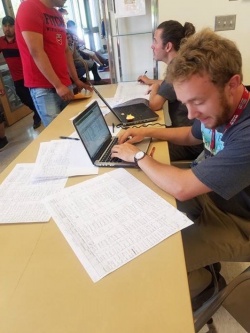
Cornell students provide assistance to farmworkers at a mobile consulate June 16 in Lansing, New York.
“With these mobile consulate visits, farmworkers avoid the extra expense and the possibility of detention should they have to travel to New York City for their documentation,” said Mary Jo Dudley, director of CFP, which is dedicated to improving the living and working conditions of farmworkers and their families. “These consulate visits are annual affairs, but this year we had about three times as many attendees. It is an indicator that the farmworker community needs the kind of support we’re providing.”
CFP worked in partnership with the Farmworker Clinic at the Cornell Law School, the Hiscock Legal Aid Society, Finger Lakes Community Health, and numerous community volunteers and service providers who assisted in providing pro-bono legal aid and medical assistance. Approximately 30 attendees received free legal advice from volunteer attorneys, and more than 40 attendees were seen by medical professionals.
“This is a critical service for people who make agriculture function in New York state,” said Matt Fischer-Daly, a second-year doctoral student in the field of industrial and labor relations and an intern with CFP. “Getting transportation and traveling to New York City, while taking time off from precarious jobs where employers have a lot of control over terms and conditions of employment, is really difficult.”
In addition to providing logistical support for the event, Cornell student interns spoke with participants to help identify where communities of need are concentrated, and through exit interviews, received feedback from farmworkers on what services are most needed. Eight students, including undergraduates from the community food system minor practicum and with support from the Cornell Office of Diversity and Inclusion, are participating in CFP’s engaged research over the summer.
“Getting to work with Mary Jo is very different from being in a classroom. You may know about what is going on from a lecture, but the experience of being in a room with families experiencing a turbulent situation is different – you forget about the narratives and connect as people,” said Maya Chang Matunis ’20, a development sociology major.
The mobile consulate is one of many continuing initiatives through which CFP provides information, services and workshops on farms, in churches, schools and community centers throughout the upstate region.


