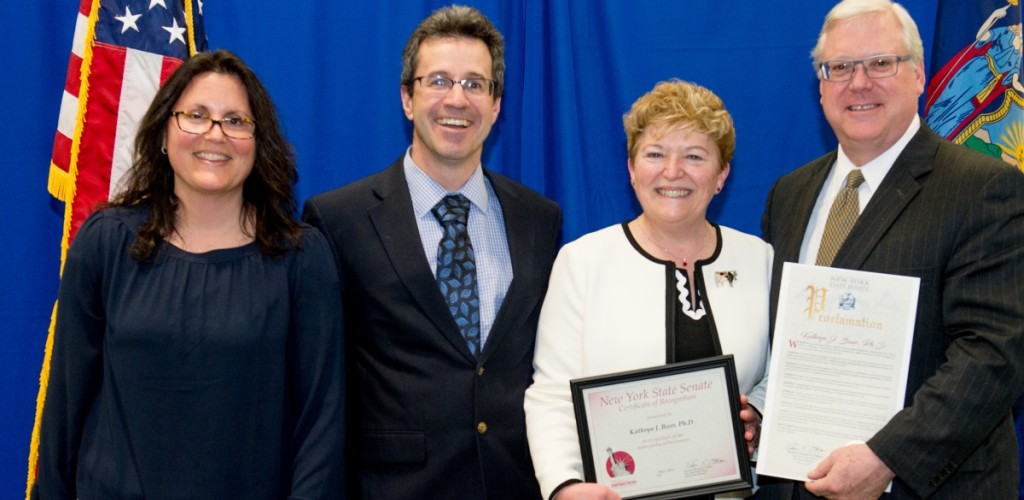
The New York State Senate honored Kathryn J. Boor ’80, the Ronald P. Lynch Dean of Cornell’s College of Agriculture and Life Sciences (CALS), as a 2018 Woman of Distinction during a ceremony May 1 at the Legislative Office Building in Albany.
Boor, a native of Chemung County and dean of CALS since 2010, was honored by State Sen. Tom O’Mara, R,C,I-Big Flats. Now in its 20th year, the program allows senators to select one honoree from their respective legislative districts for this statewide tribute.
In his announcement, O’Mara lauded Boor’s efforts to meet emerging needs spanning from farm to consumer. He praised her work revitalizing food product development and food safety training with, among numerous initiatives, the establishment of Cornell’s Institute for Food Safety. O’Mara also noted her ongoing work to establish an Institute for Digital Agriculture.
“Her commitment to New York state agriculture, and food science in particular, has long been unmatched,” O’Mara said. “She grew up on a Southern Tier dairy farm and you cannot find a stronger advocate for our dairy farmers and the dairy industry overall. Her tenure as the dean of one of the world’s foremost agricultural universities has produced landmark achievements in education, food safety, public awareness and cutting-edge research.”
He added, “Dean Boor can be proud of a remarkable lifetime of achievement and contribution up to now. But we are fortunate that she’s just getting started.”
Boor earned a bachelor's in food science from Cornell in 1980. She returned in 1994 as the first female faculty member in the Department of Food Science. As dean, she is responsible for developing and implementing the strategic direction of the college, which has 350 faculty, 3,600 undergraduate students and 980 graduate students.
During her tenure, CALS has consistently ranked as one of the top three universities in the world in both agricultural sciences, and plant and animal sciences.