

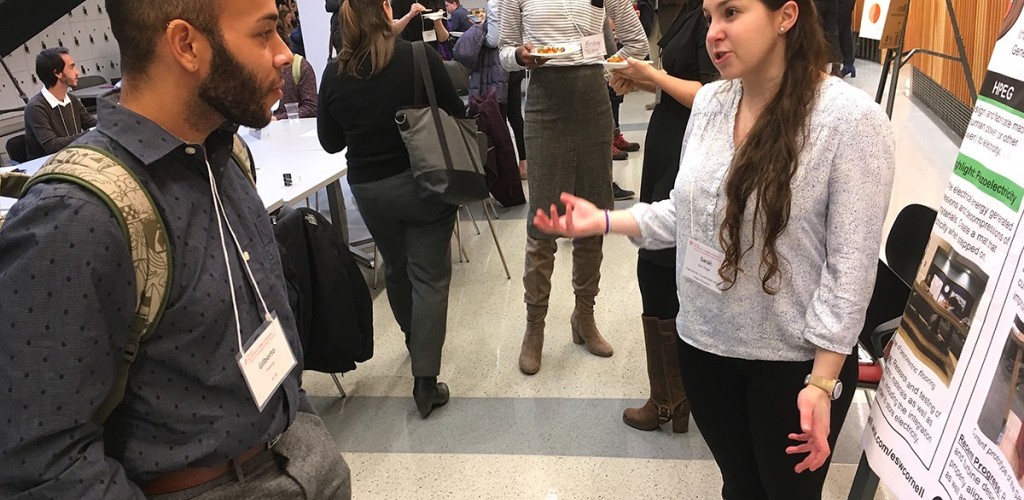
The color of money may be the best tint for keeping the world from warming its climate. That was a key message as corporate professionals gathered with students at the Cornell Business Impact Symposium, “Unleashing the Hidden Power of Sustainability,” March 10 at the Breazzano Family Center for Business Education.
Keynote speaker Mike Bowman, breakout product leader at General Electric’s Research Center, said he has hope for reducing carbon dioxide emissions, as wind and solar energy make substantial gains.
“There is an enormous North Star that people [in the corporate world] are going after that’s wrapped around sustainability,” he said. Battery storage systems are becoming better, “the wind energy business is growing like crazy – there is a massive swing toward renewable energy – and economics win out at the end of the day.”
Bowman described many ways that corporate entities are developing energy efficiency, improving the electric grid and cultivating manufacturing methods that reduce energy consumption and boost performance.
By investing in clean technology, developing business innovation, reducing environmental impact and partnering to solve environmental challenges, General Electric has added $270 billion in revenue over the past 12 years.
The carbon energy world is disappearing: “By the end of 2018, Texas will have more wind energy capacity than coal,” he said.
The symposium featured sessions on combating climate change with clean energy solutions, food for the future, improving upon the supply chain for fashion, climate mitigation, and balancing financial gain and social impact.
The symposium included a session for transitioning the U.S. to a circular economy with zero-waste in materials and resources, rather than today’s linear economy, in which a lot of products are thrown-away and there is an enormous amount of waste.
Julien Morgan ’19 said mobile devices, recycling technology, renewable energy innovation and the rise of interconnected sensing systems will enable the circular economy – all the while reducing negative environmental impacts and appealing to modern consumers.
“It will take a combination of consumer choices, market transformations, business strategies and regulatory changes to transition into a circular economy,” Morgan said.
This Business Impact Symposium, the third in a series, was initially conceived in 2015 by Samantha Kirsch ’18 as part of the undergraduate student group Sustainable Enterprise Association.
The other five student groups involved with this event were the Sustainable Global Enterprise Club, Impact Investing Club, Social Business Consultants, Cornell Sustainability Consultants and Cornell University Sustainable Design. The Center for Sustainable Global Enterprise, under the management of Monica Touesnard, associate director, and Safiyyah Abdul Hamid, center coordinator, administered the event.
Mark Milstein, director of the Center for Sustainable Global Enterprise, and Anjan Mahrok, MBA ’19, welcomed the participants.


