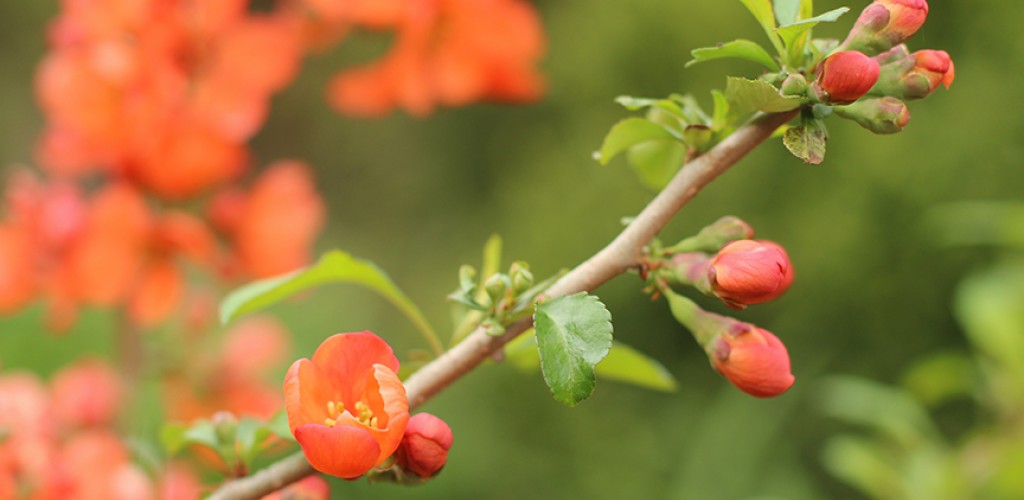
Despite outdoor temperatures hovering in the 30-degree range and snow in the forecast, the arrival of the spring equinox is a reliable sign that warmer days and more sunshine are ahead.
To savor the emergence of new life after the long slog of winter, Cornell Botanic Gardens will offer weekly “Mindful Botany” walks on six successive Fridays, April 6 through May 11, from noon to 1 p.m. These guided walks, introduced in spring 2017, encourage participants to clear their minds and dedicate their senses to observing the beauty of spring.
Walks follow the same route each week so that group members can witness the progress of a flower bud opening or measure the slow growth of the male and female cones of a pine tree.
“In all my years of working with plants, I’ve never slowed down to really examine and appreciate them as much as I learned how to do on the Mindful Botany walks,” said Dawn Dailey O’Brien, a participant in 2017.
This close, collective observation always drew the group’s attention to something new each week. A participant’s expertise in entomology helped the group notice and understand what the small, busy, green insects on the rhododendrons were doing. Another participant, an artist who loved to illustrate nature up close, prompted an appreciation for the variations in color and shape of a diversity of lichens.
Participants are invited to join as many walks as they can, although attending weekly allows walkers to more fully experience the unfurling of spring. Walks are free and open to the public, with no registration required. Meet in front of the Nevin Welcome Center.
Sarah Fiorello is an educator and interpretation coordinator for Cornell Botanic Gardens.