

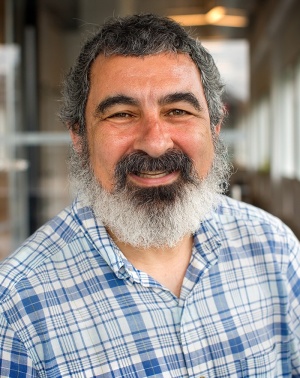
Bruce Lewenstein
What impact does communicating science have on knowledge? In a talk delivered to the Cornell Association of Professors Emeriti at Boyce Thompson Institute Feb. 20, Bruce Lewenstein argued that public communication is fundamental to science and that public disputes about reliable knowledge are not unique to our time.
Climate change, evolution and vaccines are all areas in which scientific consensus is clear, Lewenstein said, yet various segments of the public continue to debate the reliability of the consensus.
“Knowledge and belief are not the same. People know the answer about evolution but they don’t believe in it,” said Lewenstein, professor and chair of science and technology studies in the College of Arts and Sciences and professor of communication in the College of Agriculture and Life Sciences. Overcoming that gap between knowledge and belief requires scientists to engage with the public, he said.
Lewenstein described the “norms of science” that provide a framework for scientific practice. These norms include organized skepticism; universalism (science is the same everywhere); disinterestedness (science is not about the scientist but the research); and communalism – the idea that science becomes public knowledge.
Lewenstein acknowledged that tension exists between these norms and other norms in the real world, such as the conflict between an individual scientist’s commitment and the ideal of “disinterestedness,” or between organized skepticism and the organized dogma of journals wed to a particular school of thought.
In his studies of scientific communication and the “communalism” norm, Lewenstein has identified how modern technology has transformed the traditional linear model of communication. No longer is research private until a formal paper is produced and published; now, preprints are posted online and covered by the mass media before ever receiving a peer review.
“It’s a much messier system,” said Lewenstein. “Information circulates in multiple spaces.”
Lewenstein has developed a nonlinear model to illustrate how scientific information flows through the world, which he has had to frequently update as technology introduces new locations for information, such as blogs and Twitter. He pointed out the importance of these myriad sources with the example of the “meteor impact” theory of dinosaur death. “The theory was developed by physicists,” he said, “but paleontologists don’t read physics journals. They found out about the theory through media reports.”
The Cold Fusion Archive, which Lewenstein and others created at Cornell, documents another example of the nontraditional diffusion of scientific knowledge. Lewenstein explained that the cold fusion researchers announced that they had created nuclear fusion at room temperatures at a press conference, although a detailed paper hadn’t yet been published.
“The reporters ended up as the go-betweens, with scientists asking reporters for details of the as-yet-unpublished study. There were online news groups on cold fusion, and it wasn’t just reporters accessing them, but also researchers looking to see what information they could use.”
Another nontraditional route for the creation of scientific knowledge in the public sphere is citizen science, in which Cornell is a leader.
“There are lots of ways in which citizens change what we know. For example, AIDS research was shaped by patients themselves,” said Lewenstein. “It’s now no longer a debate about whether citizen science creates real science: It does.”


