

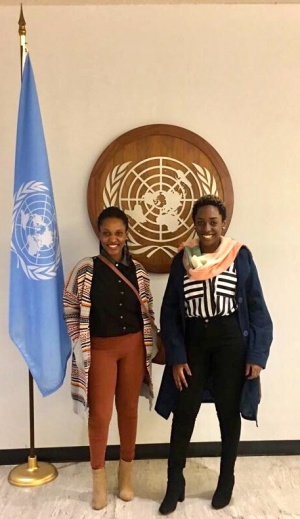
Grace Giramahoro, left, and Brenda Umutoniwase toured the United Nations Feb. 16 with nearly 90 Cornell undergraduate and graduate students. Provided.
For Brenda Umutoniwase ’20 and Grace Giramahoro ’20, a Cornell student trip to United Nations Feb. 16 furnished a glimpse into their worldly future.
“I knew a little about the United Nations, and after seeing international people and monuments gathered in one place, it was overwhelming. It was a learning opportunity,” said Umutoniwase.
Umutoniwase and Giramahoro, both from Kigali, Rwanda, and both majoring in international agriculture and rural development, hope to crisscross the globe to help improve the world when they graduate. Giramahoro wants to work for an international group, while Umutoniwase hopes to work for the Food and Agriculture Organization of the United Nations.
Giramahoro and Umutoniwase participate in Alpha Phi Omega, a service fraternity. This semester, they are helping to establish the Cornell chapter of the She’s the First organization, which strives to reduce global gender inequality and supports first-in-their-family women to graduate from high school.
About 90 Cornell undergraduate and graduate students, as well as academic fellows from across the globe, toured the United Nations. This was the 14th annual trip organized by N’Dri Assié-Lumumba, professor of African/diaspora education at the Africana Studies and Research Center in the College of Arts and Sciences; and Marcus Scales, the residence hall director of Ujamaa.
“The U.N. trip was a great experience and I hope others get an opportunity to visit,” Giramahoro said.


