

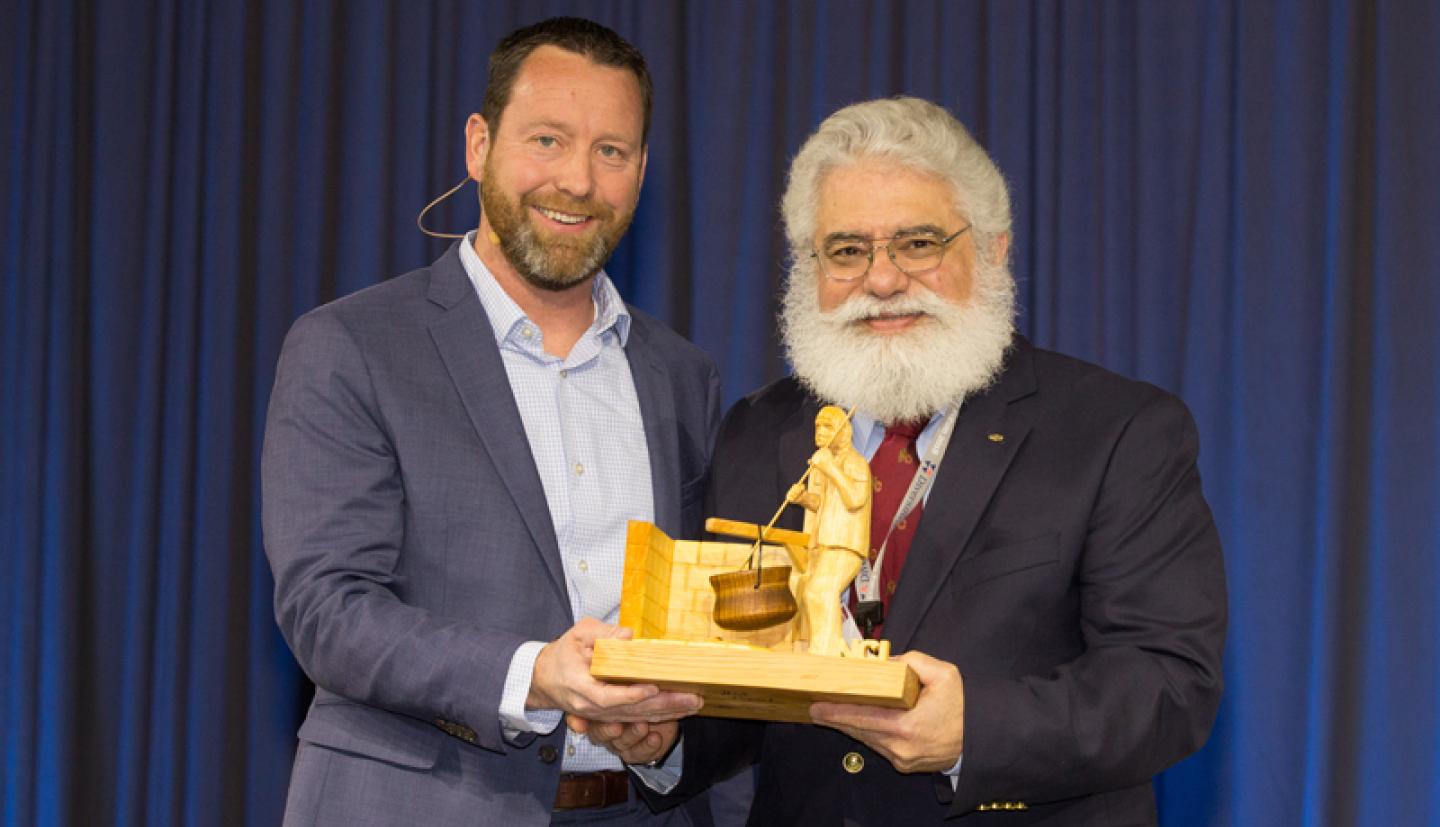
The National Cheese Institute (NCI) named David M. Barbano ’70, M.S. ’73, Ph.D. ’78, professor in the Department of Food Science, the 2018 NCI Laureate. The award recognizes individuals who have made significant long-term contributions to the development and growth of the cheese industry.
NCI chair David Ahlem, president and CEO of Hilmar Cheese Co., presented the award to Barbano at the International Dairy Foods Association’s Dairy Forum 2018 in Palm Desert, California, Jan. 22.
“The National Cheese Institute bestows its highest honor, the NCI Laureate Award, on an outstanding researcher, a prolific writer and a revered teacher,” Ahlem said, before introducing a brief video on Barbano and his achievements.
Through his research, Barbano has developed and introduced many industry advancements, including new cheese manufacturing processes that are cost effective and improve product safety. He also improved the functionality of mozzarella cheese and the sensory qualities of reduced and low-fat cheese.
Barbano has been affiliated with Cornell for more than 50 years. After earning his bachelor’s and master’s degrees in food science, he joined the department as a professor in 1980 to share his knowledge and inspire dairy students.
Barbano has significantly improved testing methods and procedures for all dairy products, and his research on the chemistry and processing of dairy foods helped to develop many innovative solutions. He has published more than 85 peer-reviewed articles related to the cheese industry and trained more than 60 graduate students, many of whom are making contributions to the industry.


