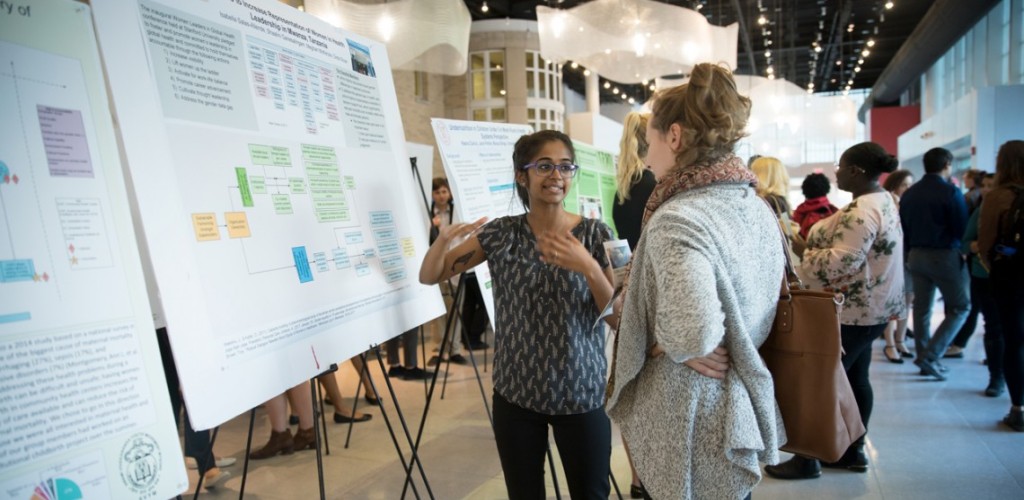
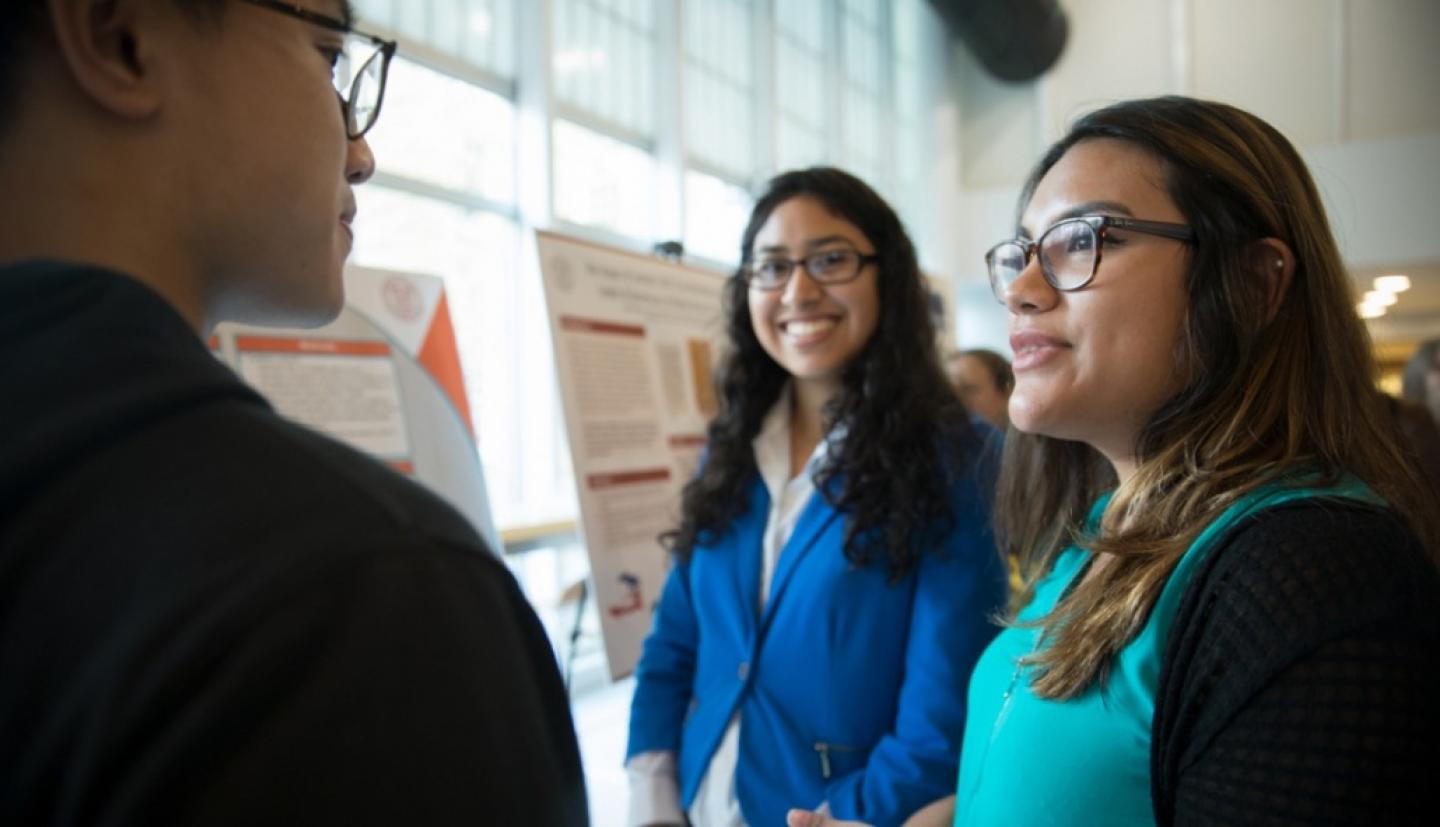
More than 40 student teams gathered Nov. 3 to present their experiences with global and public health learning as part of the Global and Public Health Experiential Learning Symposium, hosted by the Cornell Global Health Program and its Student Advisory Board. Held in Martha van Rensselaer Commons, the teams used poster boards to present on a variety of international and domestic health issues.
The Global Health Program, managed through the Division of Nutritional Sciences, offers students from any field of study the opportunity to explore and apply global health knowledge through experiential learning.
Student’s work spanned 10 countries and addressed topics ranging from maternal death rates in northern Ghana to malnutrition in young Tanzanian children. A number of teams traveled abroad to their country of study as a part of their project, while others had visited their country of focus prior to selecting their topic and were inspired to study health issues within the country as a result.
This past summer, students Ijeabalim Nnachetta ’18 and Panagiotis Sarris-Michopoulos ’18 traveled to Moshi, Tanzania, as part of Cornell’s Global Health Summer Program, which engages Cornell undergraduate students and Tanzanian medical students from Kilimanjaro Christian Medical University College (KCMUCo) in problem-based learning in a cross-cultural, small-group context. Students learn about current policy issues and work in teams to develop, negotiate, write and present a new global health policy case study relevant to the Kilimanjaro Region of Tanzania. Nnachetta and Sarris-Michopoulos researched hospital-acquired infections in the medical center’s surgical ward, conducted interviews, provided analysis and brainstormed solutions to combat the acquisition of new infections.
Nnachetta said one of the most challenging aspects of the experience was ensuring that people’s interests were presented in a manner that was, in her words, “as comprehensive and unbiased as possible.” She said the language barrier posed some difficulties as well; however, she said that for her the experience as a whole “stimulate[d] further interest in public policy.” Nnachetta and Sarris-Michopoulos’s team also included two students from KCMUCo, David Nathan and Naelijwa Manongi.
Alekhya Chaparala ’17 was part of a team that focused on attempts to reduce adolescent pregnancy rates in the slums of Bangalore, India. The team, which also included Linda Asare ’18, Lizetta Alexander ’18 and Winnie Ho ’19, studied approaches such as conditional cash transfer, wherein families are paid for certain milestones or experiences their daughter achieves, such as being immunized, enrolling in school or not marrying before the age of 18. In this way, Chaparala said, the conditional cash transfer provides economic incentives to parents to prevent their daughters from giving birth in adolescence.
Chaparala said one aspect that drew her and her team to the topic was the high literacy rate found in Bangalore’s slums. Since low literacy rates are often linked to high rates of teenage pregnancy, the situation in Bangalore poses a contradiction to researchers, which Chaparala said intrigued her team.
“What is going on in the other half of Bangalore that we don’t always see on the Indian news?” Chaparala asked, and noted the contrast between the middle class’s technological presence in Bangalore and the status of the urban poor was another aspect that drew her team to their chosen subject.
Meanwhile, Elizabeth Cha ’19 and Mira Ramesh ’19 focused their efforts on social protection in Namibia and Zambia. Due to the efficacy of Namibia’s social protection plan in lessening poverty, Cha and Ramesh wondered if a similar program could be implemented in Zambia, a country with some similarities to Namibia. Cha and Ramesh were participants in Cornell’s Global Health Summer Program in Lusaka, Zambia, where they conducted health policy research with the Southern African Institute for Policy and Research.
Teagan Todd ’20 is a writer for the Cornell Chronicle.