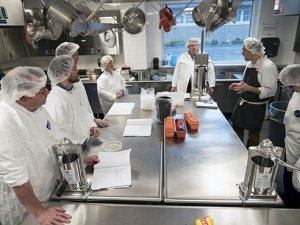
Justin Paterson, owner and chef of Trumansburg’s Hazelnut Kitchen, removed fear from the recipe books when he taught restaurateurs, extension educators and foodies “Small Scale Charcuterie” in Stocking Hall Nov. 6.
Touring the gastronomical universe, Paterson unveiled the ease with which pate, duck rillettes or duck confit can fit into your repertoire. The chef started the students in creating a savory Italian sausage, a basic terrine and spreadable bacon spuma. “Spreadable bacon is always a crowd-pleaser,” Paterson told the students. “Bring this to a party and everybody will be your friend.”
While students worked all day creating delicious delights, Bruno Xavier, a Cornell extension associate and an authority on food processing, explained how to keep kitchens safe from listeria, E. coli, salmonella and botulism.
Cornell Cooperative Extension created Harvest New York to help industry professionals add value to agriculture, learn food safety and, with dairy foods extension, hold workshops throughout the year around Ithaca and throughout the state.
MacKenzie Waro, livestock processing and marketing specialist for Harvest New York, designed the workshop with Paterson.
“We are aiming to increase the profitability of the state’s meat industry, and through workshops like these, bring producers and chefs together to help grow the industry,” said Waro.
Incidentally, Paterson, along with chefs Dano Hutnik and Karen Gilman of Dano's Heuriger in Lodi, New York, will be featured at a Finger Lakes holiday dinner at the James Beard Foundation Dec. 12 in New York City.