

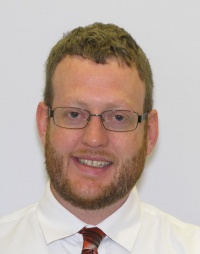
Adam Howell
Adam Howell, communications specialist for the Cornell Local Roads Program, is now the Employee Assembly (EA) representative for the College of Agriculture and Life Sciences.
Howell joins four other new members who joined the EA to fill vacant seats. He said he is looking forward to having “a positive impact on our university community.” Howell is a native of Illinois who moved to Ithaca in early 2016 with his wife Donna. An avid hiker, camper and nature lover, he enjoys spending time with their baby boy Harrison and dog Daisy.
The EA consists of 28 members, representing the community of Cornell employees, and is committed to providing staff with a means of continuous involvement in the governance of the University. Working closely with members of the administration, the EA encourages higher visibility for employees as community members, more equal participation with faculty and students in the policy-making process, and an increased sense of community through shared responsibilities.
The EA meets the first and third Wednesdays of each month, 12:15-1:30 p.m., usually in 401 Physical Sciences Building but check the meeting website. All staff are welcome to attend any of the EA general meetings and to join any of its committees. For more information, see the EA website.
The other four newest members are:
- Arla Hourigan, graduate education manager and now EA representative for the College of Veterinary Medicine.
- Andrea Haenlin-Mott, the new EA representative for Infrastructure, Properties & Planning (IPP), is the Americans with Disabilities Act (ADA) coordinator for that division.
- Daniela Harris, EA disability representative, is Cornell’s lead Title IX investigator.
- Hei Hei Depew, EA representative for staff working at Cornell for less than five years, has been a financial professional at Cornell for two-and-a-half years. She has worked at Engaged Cornell and is now working at the College of Human Ecology.
A version of this article appeared in the Cornell Chronicle.


