

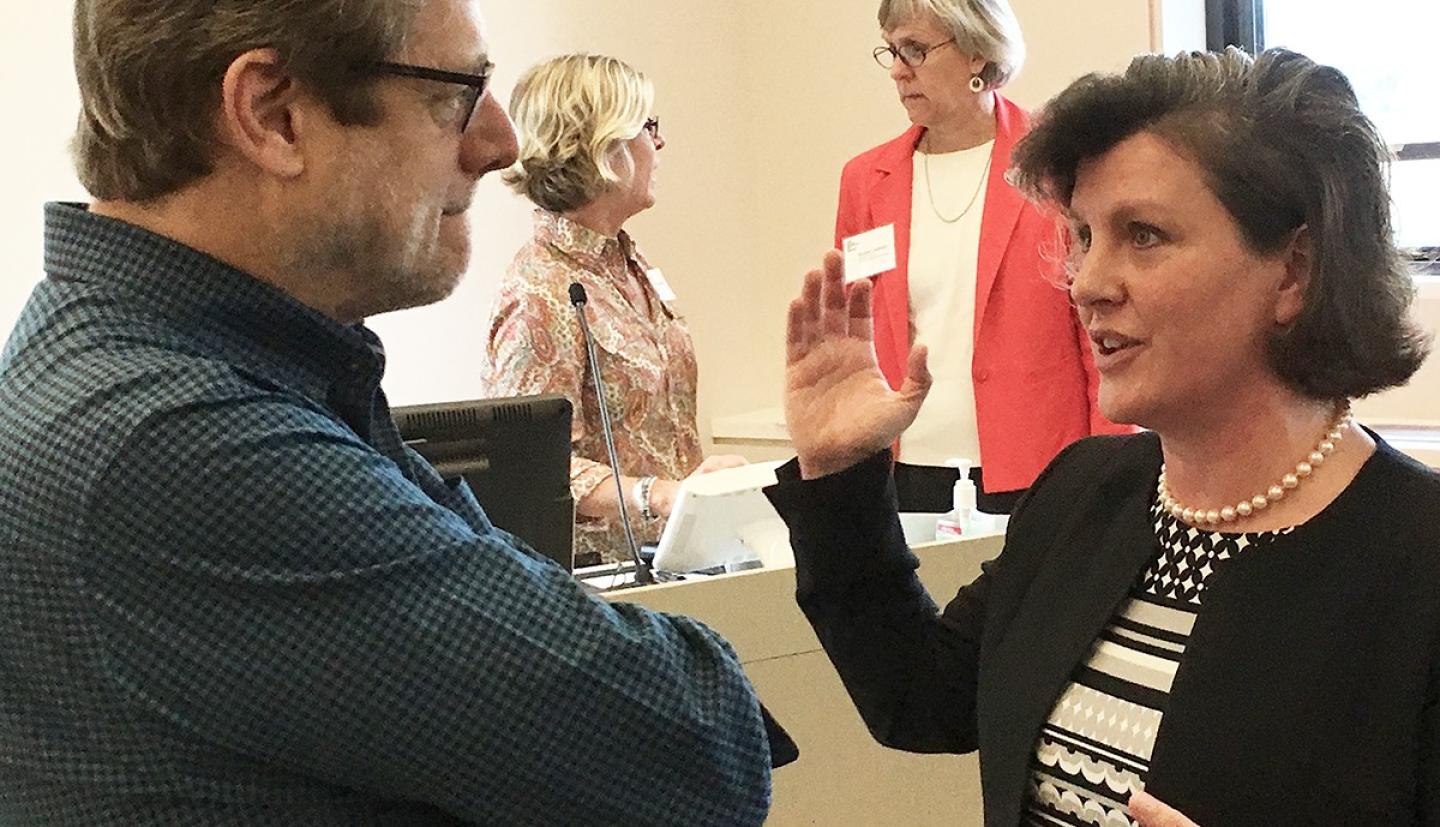
Inventive and innovative medium-size cities have overtaken the federal government as engines of economic growth, according to Syracuse, New York, Mayor Stephanie Miner in a keynote talk at the 2017 Community Development Institute Sept. 28, hosted by Cornell’s Community and Regional Development Institute (CaRDI).
“These cities … have a brighter-future promise for all of us, but that promise has to be nurtured or it will be lost,” Miner said.
Miner pointed to the Erie Canal, the engineering marvel of the 19th century, as an example of infrastructure creativity. The canal required a substantial economic investment, and the engineering feat transformed and opened the nation, she said: “It was infrastructure. We accomplished the unthinkable.”
More than 100 attended the two-day conference, “Building Sustainable Communities: Global Forces, Local Focus.” The conference examined growing education and income inequality in New York state, climate change impacts on communities, the state’s immigration trends, local government fiscal stress, building the state’s sustainable food systems and fostering university-community partnerships.
Miner said that mid-sized cities like Syracuse, Rochester and Buffalo bring new energy and drive economic sustainability in the United States today, and she called them “the real diamonds.”
“These middleweights generate 70 percent of the so-called gross domestic product. … And that’s where Syracuse is … the success of the American economy is due to the success of cities like Syracuse, Rochester and Buffalo.”
But these cities need help, she said. Federal and state governments hobble local governments by withholding much-needed funds. “What the state government is often asking local governments to do is to run America with [an orthopedic walking] boot and crutches – but now share that boot and crutches with other local governments,” explained Miner. “Because somehow if we share the boot and crutches with other local governments, we will somehow finish better and faster – and the people we represent will get better and cheaper services.
“It’s sophistry,” Miner said.
Local governments today thrive by using their savvy – through innovation, creativity and solving problematic infrastructure issues, the mayor said, but that these traits seem lost at the state and federal levels.
Miner said: “Our history is characterized by innovation, perseverance and progressivism. … But rather than look back on history with a sense of nostalgia … use this history and modern data as a guide to a brighter future … so that we can escape the peril that otherwise would face us.”


