


As climate change threatens coastal cities with rising waters, creative solutions are increasingly needed to preserve not only land, buildings and resources, but also histories and cultures.
In the Hudson Valley, waterfronts are under pressure from the rising Hudson River. To mitigate problems, landscape architecture students in the Cornell Climate-Adaptive Design studio created plans to revitalize a 38.3-acre site along the Kingston Point waterfront. One sustainable design received an Honor Award from the American Society of Landscape Architects (ASLA) at the organization’s annual meeting Oct. 23 in Los Angeles.
Graduate students Hong Gao, Luyao Kong and Qianli Feng received the prestigious award for Weaving the Waterfront, a design that combines climate-resilient programs and public spaces. The ASLA Awards recognize top work of landscape architecture students around the world. Awards in the student general design category honor site-specific student work of landscape architecture with an emphasis on quality of design, environmental sensitivity and sustainability, and design value.
“The student design team did a fantastic job of working collaboratively together, incorporating feedback from our partners to propose multiple interventions that could be phased in over time,” said Joshua Cerra, associate professor of landscape architecture and the team’s faculty adviser.
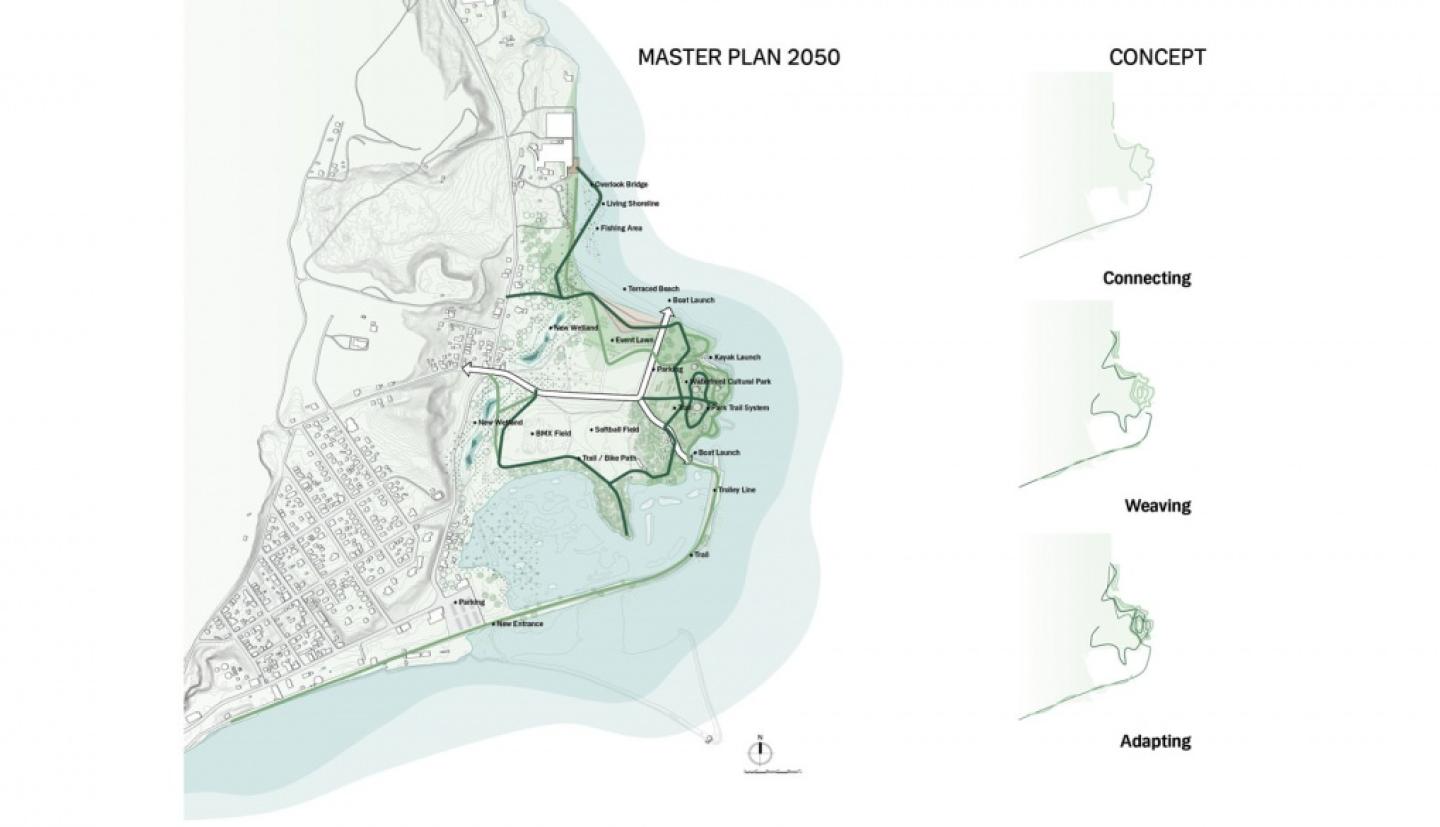
The team’s winning proposal looks ahead to climate change resiliency as well as backward to the Kingston waterfront’s rich history. With their design, Gao, Kong and Feng proposed restoring, reinforcing and reinvigorating the recreational site, which includes Kingston Point Beach and Rotary Park.
An awards jury member called the work “a really smart project. It clearly explored three strategies and proposed a design that will work for 100 years.”
Frequent flooding from hurricanes and tropical storms as well as sea level rise are expected to subsume a large portion of the waterfront and weaken the shoreline, impacting the types and structures of wetland habitats and the level of biological diversity. Because the Kingston Point waterfront serves as a buffer zone between the city of Kingston and the river, addressing its ability to cope with these changes has taken on new significance.
“By engaging communities in the studio design process,” Cerra said, “we hope to inspire municipalities in the Hudson River Valley to begin the process of adaptation now, so that they are prepared as conditions change over time.”


