

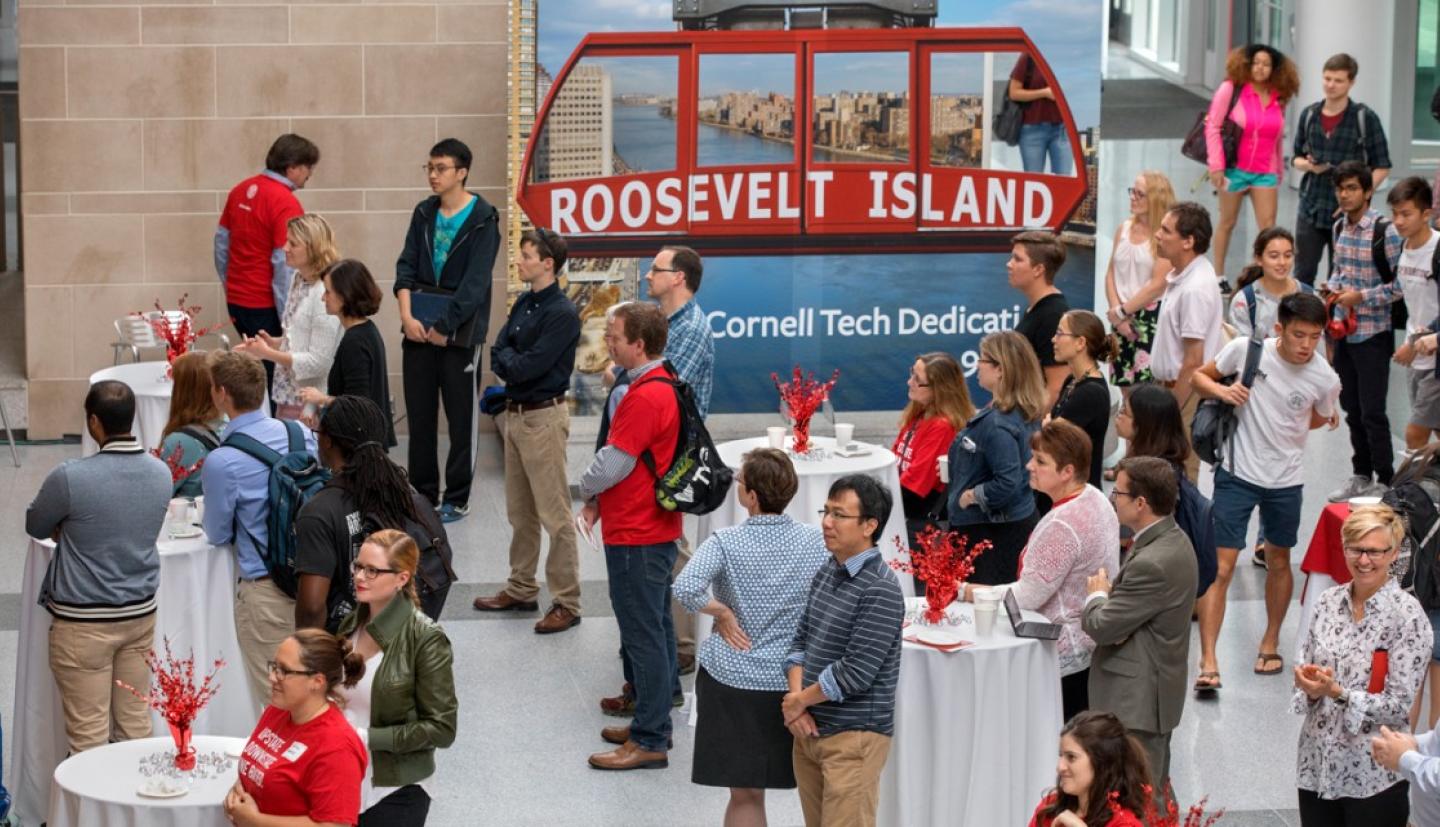
Far above Cayuga’s calm waters, Cornell students, faculty and staff gathered Sept. 13 to celebrate events bounded by the fast-flowing East River: The opening of the Cornell Tech campus on New York City’s Roosevelt Island.
The morning crowd of a few hundred people bore witness to Cornell history via livestream shown on large-screen TVs in the Physical Sciences Building atrium. Prior to the event, groups of smiling people gathered to take photos with a cutout of the Roosevelt Island tram.
The commemorative T-shirts handed out at the event helped sum up the excitement and pride in the historic occasion: “Upstate. Downstate. One Big Red.”
“The buildings look beyond fantastic, as Cornell continues to extend itself in New York City,” said Lawrence Kwong ’21, a biology major from Brooklyn, who saw the campus under construction on Roosevelt Island and was familiar with Cornell Tech. “This will be an amazing hub for very competitive, technological impact.”
Alex Martell ’19 knows the new campus is an environmental marvel that features new ways to heat the new buildings. “This will be a very green campus, and it is super revolutionary,” he said. “We’ve been seeing hurricanes spurred by global warming. This campus is cool, because they designed it for sustainable, renewable energy. … It sets a precedent that others can achieve.”
Professionally speaking, Pamela Tan ’97, director of admissions for the College of Agriculture and Life Sciences, said she is excited to see Cornell Tech open its doors on Roosevelt Island. “When I speak to prospective students and their parents, many of them know all about this new campus,” said Tan. “They’re quite excited about the future opportunities this presents.”
Shea Belsky ’18, studying information science, explained he’s been excited about Cornell Tech since the beginning – when he was in high school just north of New York City. “The fusion between Cornell Tech and New York City – well, it’s going to be Silicon Alley,” he said.


