Rather than conduct an aquatic roll call with nets to know which fish reside in a particular body of water, scientists can now use DNA fragments suspended in water to catalog invasive or native species.
The research from Cornell, the University of Notre Dame and Hawaii Pacific University was published July 14 in Methods in Ecology and Evolution.
“We’ve sharpened the environmental DNA (eDNA) tool, so that if a river or a lake has threatened, endangered or invasive species, we can ascertain genetic detail of the species there,” said senior author David Lodge, the Francis J. DiSalvo Director of the Atkinson Center for a Sustainable Future at Cornell, and professor of ecology and evolutionary biology. “Using eDNA, scientists can better design management options for eradicating invasive species, or saving and restoring endangered species.”
Additionally, by sampling DNA fragments in water and using polymerase chain reaction (PCR) technology, which acts like a genetic copying machine to make billions of copies of the DNA for study, scientists can collect fish habitat data without the need to capture fish.
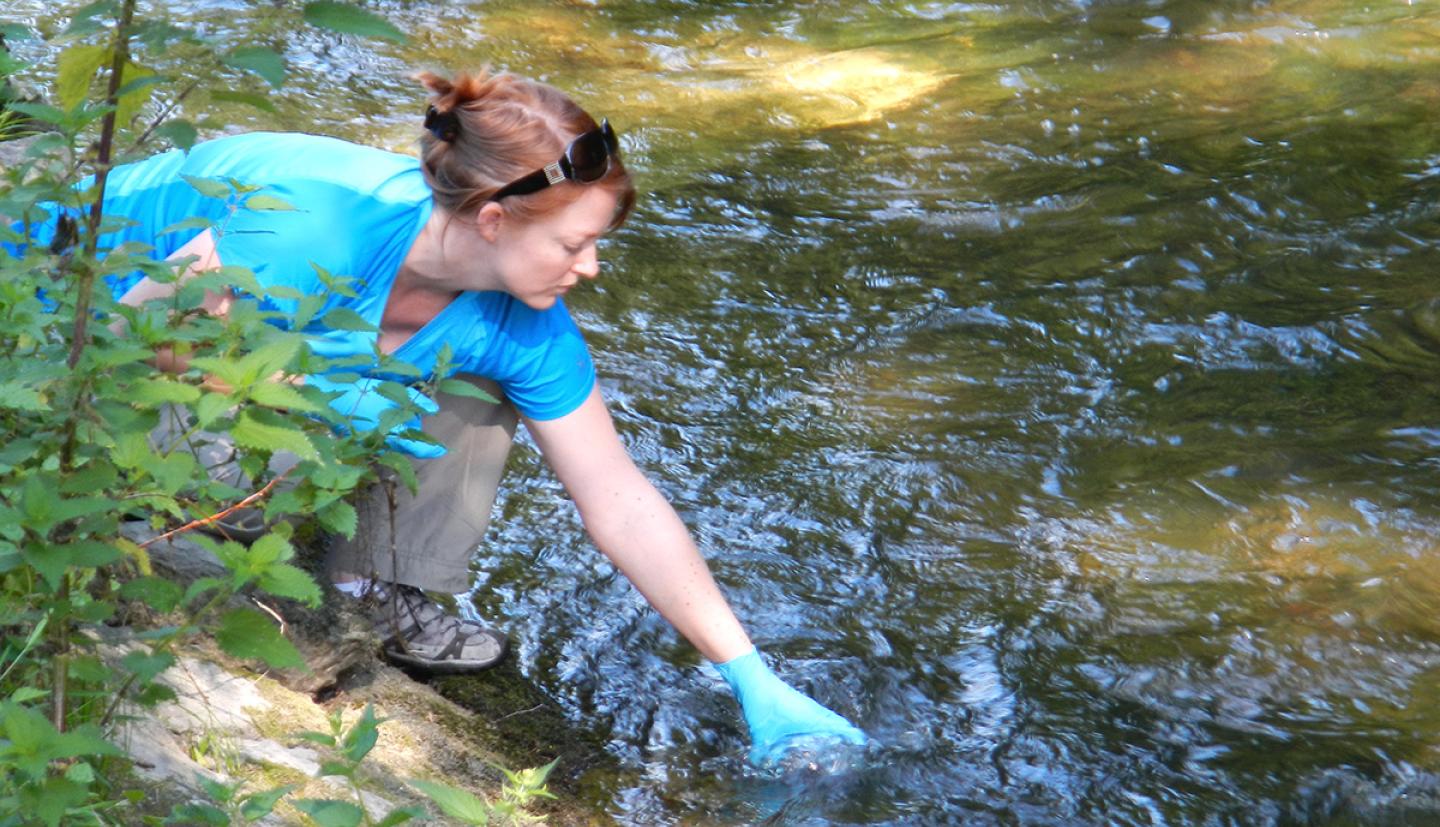
Research begins with a small water sample from a stream, lake or river. “Fish have millions of cells, and when they swim they leave a trail of cells behind. So, we’re using the whole mitochondrial genome of these cells to track fish,” said Kristy Deiner, a Cornell postdoctoral researcher and a co-lead author on the paper.
Biologists have commonly assumed that fish DNA extracted from water bodies is of poor quality and highly degraded. As it turns out, the new study is the first to show the opposite is true. In a stream, for example, large strands of fish DNA remain intact.
“We’re getting closer to what forensic scientists do at a crime scene every day. They’re not interested in whether any humans were at a crime scene, they’re interested in knowing which humans were at the crime scene,” said Lodge.
As an example, Lodge said, Asian carp have long been an invasive species in Chicago’s canal system. “All we could say was ‘Yes, there are Asian carp here,’” he said. “With this technological breakthrough, we are getting closer to learning how many there are – based on the genetic differences between individuals – and potentially even where they came from. Then, researchers can gauge the situational danger and ask, ‘Can we close off the source of these invasive fish?’”
On using this technology, Deiner said, “If we catch an invasion early enough, for example, it’s possible to eradicate the population and prevent the invasion from continuing.”
Other authors on the paper, “Long-Range PCR Allows Sequencing of Mitochondrial Genomes from Environmental DNA,” are co-lead author Mark A. Renshaw and Brett Olds of Hawaii Pacific University; and Yiyuan Li and Michael E. Pfrender of Notre Dame. The research was supported by the U.S. Department of Defense’s Strategic Environmental Research and Development