

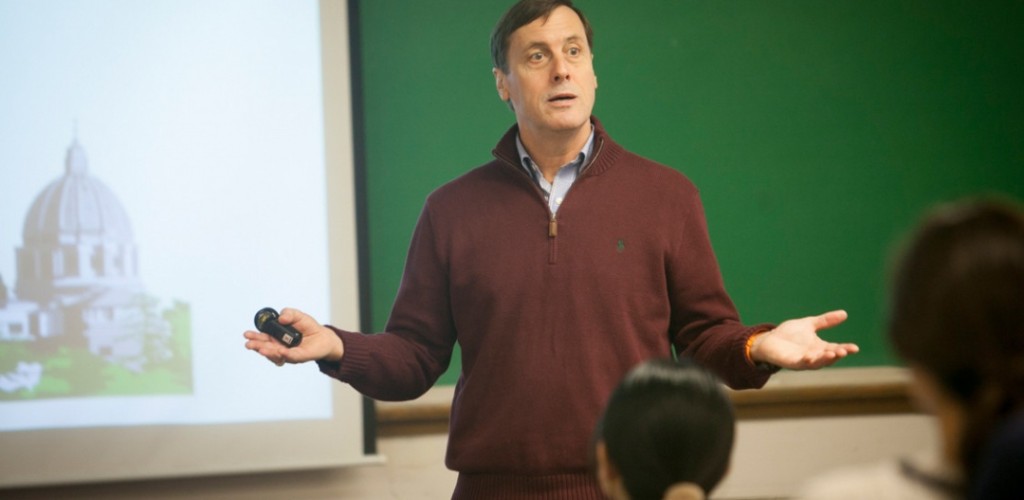
The chance to solve real-world problems has always motivated Harry Kaiser. While studying economics as a graduate student, he turned to the agricultural sector to make the greatest impact. Since then, his work has tackled such questions as how climate change affects food production and how taxes on unhealthy food drive nutritional choices.
In recognition of his research and its impact, Kaiser, associate dean for academic affairs of the Charles H. Dyson School of Applied Economics and Management and the Gellert Family Professor of Applied Economics and Management, has been named a 2017 Agricultural and Applied Economics Association (AAEA) fellow. The fellowship, which will be presented July 31 during the 2017 AAEA Annual Meeting in Chicago, recognizes contributions to the advancement of agricultural and applied economics in research, undergraduate and graduate teaching, extension/outreach and service.
While his major scholarly contributions span dairy policy, climate change, commodity promotion and experimental economics, Kaiser’s current primary research addresses food policy and the economics of advertising.
“I’ve always enjoyed being able to see the tangible outcomes of my research,” Kaiser said. “For example, how do taxes on soda and unhealthy food influence people’s behavior? Likewise, do subsidies for healthy foods play a role? And what role does advertising play?”
Examining a range of policies, such as fat and sugar taxes, healthy food subsidies, anti-obesity advertising and menu format labels, Kaiser has concluded that peer pressure is a more effective motivator than financial pressure.
“While fiscal policies, such as taxes and subsidies, tend to be effective over the short-term, the majority of people eventually revert back to their original behavior. Behavioral strategies, such as television advertising, tend to have more of a lasting impact,” Kaiser said.
An early pioneer of research on the economic impacts of climate change on U.S. agriculture, in the 1990s Kaiser led a large multidisciplinary project that showed crop production would prevail even under severe conditions. Today, this study is still considered one of the most important on the subject.
Kaiser’s resulting book, co-edited with Thomas Drennen, “Agricultural Dimensions of Global Climate Change,” was the first book published on agriculture and climate change.
Kaiser is also highly regarded as a classroom teacher. He continues to teach courses in price analysis, marketing, dairy policy and mathematical programming to undergraduate and graduate students.


