

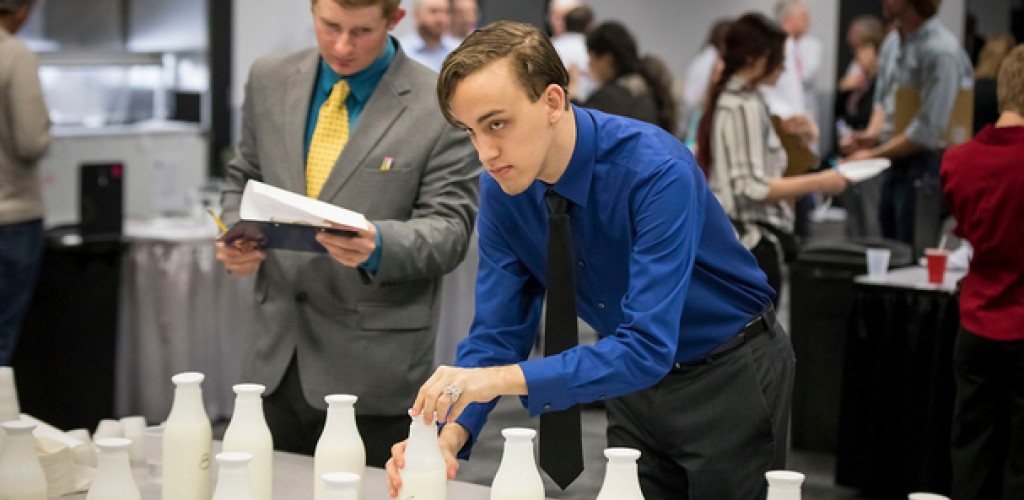
Tom Reis '19 at the Collegiate Dairy Products Evaluation Contest in April. Mike Roemer/Roemerphoto
With a sniff, savor and a sip, Cornell’s Dairy Products Sensory Evaluation team returned to the century-old National Collegiate Dairy Products Evaluation Contest after a 30-year hiatus.
Students from colleges across the country tested their palates against professional judges in the fluid milk, butter, yogurt, cheddar cheese, cottage cheese and ice cream categories.
Libby Brown ’18 scored yogurts, and said she was surprised at the varying textures and tastes. She evaluated milks and used her trusty twisty cheese trier to carve cylindrical chunks of cheddar. “I love cheddar cheese, which made it a little hard to rate it for defects since it all tasted delicious to me,” she said. “I then moved on to my favorite – ice cream.”
This year, Cornell was one of 14 colleges at the 96th competition, held in mid-April in Madison, Wisconsin. Other team members are Thomas Reis ’19, Brendon Horigan ’17, Ana Chang, M.S. ’17 and Sofia Lara, M.S. ’18.
Established in 1916, the contest was designed to find quality defects in dairy products so they could be corrected, said Cornell coach Carmela Beliciu, of Cornell Cooperative Extension. The contest gives students the opportunity to showcase their evaluation skills and prepare for careers in the dairy industry.
The competition was once called the “Students Butter Judging Contest,” and Brown tasted butter, too. “I like butter on things, but eating chunks of butter is a little difficult to do,” she said. “Unlike store-bought stick butter, these giant blocks were not oxidized and some tasted delicious.”



