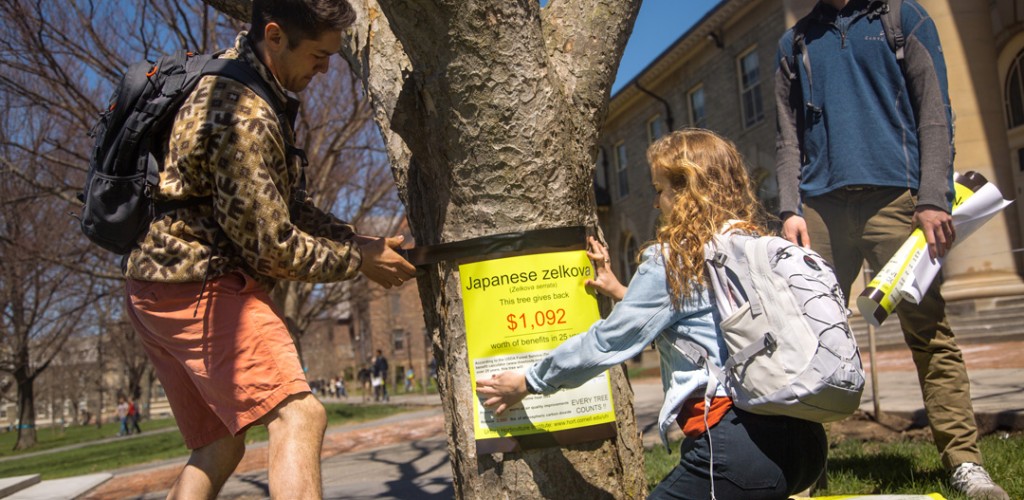
Students in the class Creating the Urban Eden on April 18 determined the value of trees on the Arts Quad based on energy savings and environmental impact. Over 25 years, this Japanese zelkova gives back $1,092 in savings and will intercept more than 123,000 gallons of stormwater runoff. Photo by Jason Koski/University Photography.
A collection of Arts Quad trees now sport price tags, but they’re not for sale.
The tags highlight the dollar value of the ecosystem services the trees provide, including energy savings, intercepting storm water runoff, air quality improvements, and greenhouse gas reductions. Students placed the tags with monetary values on about 80 trees April 18, part of the course Creating the Urban Eden in the College of Agriculture and Life Sciences.
“We celebrate trees on Arbor Day. We celebrate the Earth on Earth Day. This activity ties the two together to make people more aware of all the benefits trees provide to the environment,” said horticulture professor Nina Bassuk, who leads the class alongside landscape architecture professor and chair Peter Trowbridge. The class teaches future landscape architects and horticulturists how to identify and choose woody plants that can provide ecosystem benefits while standing up to the tough conditions often faced in urban environments.
Arbor Day, April 28
Cornell is beloved for its many natural areas and trees. Cornell Botanic Gardens includes natural areas, an arboretum and cultivated gardens. Within its 3,400 acres, Cornell Botanic Gardens alone contains:
- 1,106 taxa of trees
- 480 taxa of conifers
- 11 tree collections in its arboretum
- and six endangered tree species.
The students determined tree values using i-Tree Design, an online assessment tool developed by the U.S. Forest Service, to calculate the trees’ benefits based on the species, size and location of the tree. Trowbridge said the i-Tree calculations have broad implications for young landscape architecture practitioners.
“Their ability to do these calculations assist communities, institutions and clients in selecting certain tree species and tree locations that provide the greatest environmental values,” said Trowbridge. Trees located near buildings can provide direct dollar savings on heating and cooling costs.
Bassuk directs the Urban Horticulture Institute, a program that integrates plant stress physiology, horticultural science, plant ecology, and soil science. The institute’s outreach resources include the Woody Plants Database, a website that helps you match plants to your location.
“All trees take up carbon dioxide and store it in their wood, helping to reduce climate change,” said Bassuk. For example, a large sweetgum near White Hall was estimated to sequester more than 7 tons of carbon dioxide while also intercepting more than 100,000 gallons of storm water runoff over 25 years.
The tree-tagging has been a regular event on the Ag Quad since 2013. Due to construction there, the students decided to move the event to the Arts Quad.
“We’re reaching a new audience there who will hopefully learn that trees are more than just pretty faces in the landscape,” said Bassuk. “They are also real workhorses in the environment that return important, tangible benefits.”