

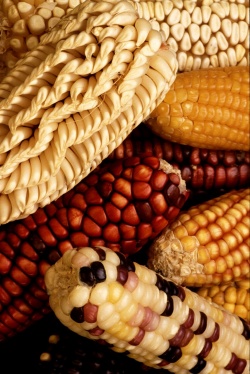
Over many thousands of years, farmers have bred maize varieties so the crops are optimally adapted to local environments.
A new study, published Feb. 6 in Nature Genetics, analyzed close to 4,500 maize varieties – called landraces – bred and grown by farmers from 35 countries in the Americas to identify more than 1,000 genes driving large-scale adaptation to the environment.
“The study provided a powerful catalog of the genes necessary for corn to adapt to different latitudes and elevations across the world,” said senior author Edward Buckler, a research geneticist at the USDA-Agricultural Research Service and adjunct professor of plant breeding and genetics at the Institute for Genomic Diversity at Cornell.
“It takes a thousand genes to attune a plant for a particular latitude and the elevation where it is grown. That’s what we are mapping here,” Buckler said.
The researchers also identified genes associated with flowering time – the period between planting and the emergence of flowers, which is a measure of the rate of development. Flowering time is a basic mechanism through which plants integrate environmental information to balance when to make seeds instead of more leaves.
“Flowering time is the trait that is most correlated with every other trait,” Buckler said. The study found that more than half of single nucleotide polymorphisms (the most basic form of genetic variation) associated with altitude were also associated with flowering time, revealing these traits are highly linked.
Current technology, including a new rapid experimental design called F-One Association Mapping (FOAM), allowed the researchers to use the collection of diverse maize varieties to figure out which genes were important for adaptation.
“With global climate change over the next century, we can directly use this information to figure out what genes are important” to greatly speed up breeding efforts of maize, Buckler said. “We’re tapping the wisdom of farmers over the last 10,000 years to make the next century’s corn.”
Sarah Hearne, a molecular geneticist at the International Maize and Wheat Improvement Center (CIMMYT) and a maize research lead scientist with Seeds of Discovery, is also a senior author of the paper. J. Alberto Romero Navarro, a doctoral student in plant breeding and genetics, is the paper’s first author.
Hearne and colleagues at CIMMYT envisioned the project, led the logistical efforts and conducted field trials, while Romero, Buckler, and Cornell colleagues led the genomic analysis of the data.
The study was supported by Mexico’s Ministry of Agriculture, Livestock, Rural Development, Fisheries, and Food through the Sustainable Modernization of Traditional Agriculture initiative. Additional support from the USDA-Agricultural Research Service, Cornell University, and the National Science Foundation facilitated the completion of the data analysis.


