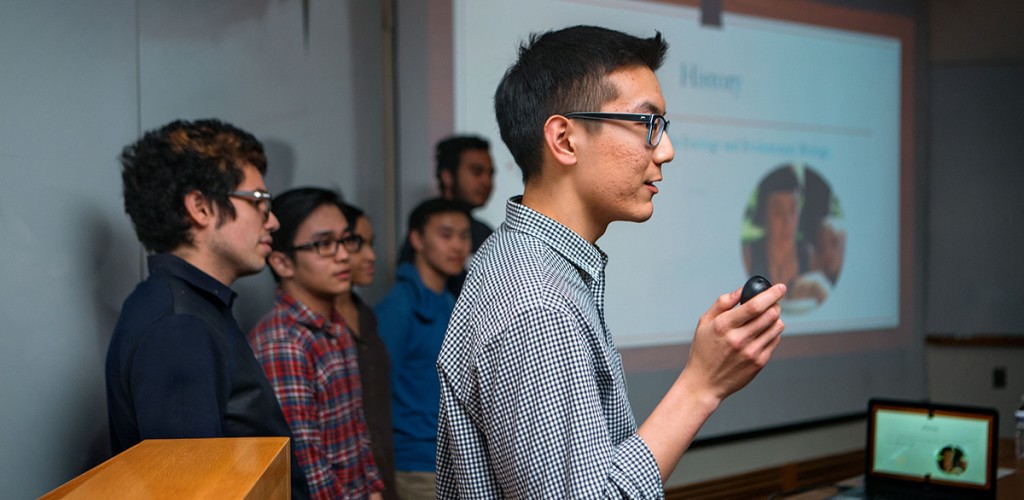
Students shared their experiences performing community service in the Ithaca area as part of the Office of Undergraduate Biology’s Biology Service Leaders (BSL) Showcase Feb. 9 in Corson Mudd Hall.
The students were organized into project teams, each of which focused on either giving back to the Ithaca community or strengthening the on-campus community at Cornell. Students used the showcase to highlight their projects’ achievements and goals for the future.
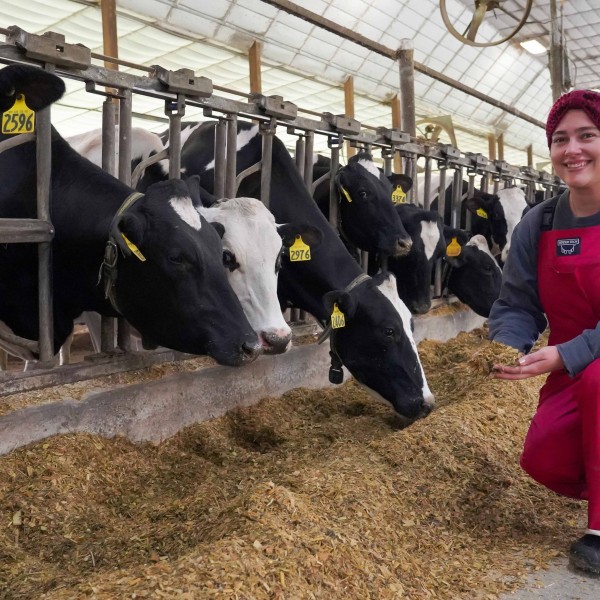
All of the services provided by the students are tied to the study of biology. Several teams, such as STEAM, STEP UP, and the Cayuga Lake Floating Classroom, work with elementary and middle school children. STEAM uses creative, hands-on activities such as painting and archeological digs, to enrich students’ understanding of science. STEP UP trains students at local schools in Science Olympiad events. The Cayuga Lake Floating Classroom touches on issues involving the watershed and waterways and has worked with the American Fisheries Society to provide dissection activities for the children.
One team, composed of undergrads Heejin Lim ’17 and Pooja Shah ’17, works with the Tompkins County Advocacy Center to improve high school students' understanding of issues, such as sexual health and abusive relationships. Another team works with Healthy Food for All, a nonprofit program of Cornell Cooperative Extension of Tompkins County, which seeks to improve nutrition for poor families with the help of local farmers. The project has raised $5,000 and hosts seasonal harvest dinners to benefit the program.
Meanwhile, the Cornell Health Initiative team seeks to improve students’ relationship with Gannett Health Services and to decrease antibiotic misuse on campus.
All of the project teams emphasized the importance of having community partners who were willing to work toward a shared goal. Several teams also expressed an interest in hosting more of their work on campus as a means strengthening ties to the local community.
Co-advisers Colleen Kearns and Wendy Aquadro, of the Office of Undergraduate Biology, said they admire the commitment of team members and appreciate the learning and flexibility that members develop in the program.
“Participation in BSL has helped members tie together their interests in both biology and service while also building leadership skills,” said Aquadro, senior associate director of advising. The BSL is a joint venture supported by the Office of Undergraduate Biology and the Public Service Center.
Keynote speaker Amy Somchanhmavong, associate director of community service-learning and partnership at the Cornell Public Service Center, shared her experience with community service and discussed the importance of leadership with a quote from Marshall Ganz, senior lecturer Harvard University’s Kennedy School of Government: “Leadership is accepting responsibility to create conditions that enable others to achieve shared purpose in the face of uncertainty. Leaders accept responsibility not only for their individual part of the work, but for the collective whole.”
Somchanhmavong said community service could be described with “two Ls and one A”: learning, loving, and action. “Take ownership of your learning,” she said. “Take the time to develop and affirm your identity.” Somchanhmavong also said students should “work from [their] heart and with [their] heart” and should take action on something they believe in.
“Think about your why. Why are you interested and what is it that motivates you?” Somchanhmavong said.
Several dozen people attended the event, many of whom were the project’s community partners.
Teagan Todd ’20 is a writer intern for the Cornell Chronicle.