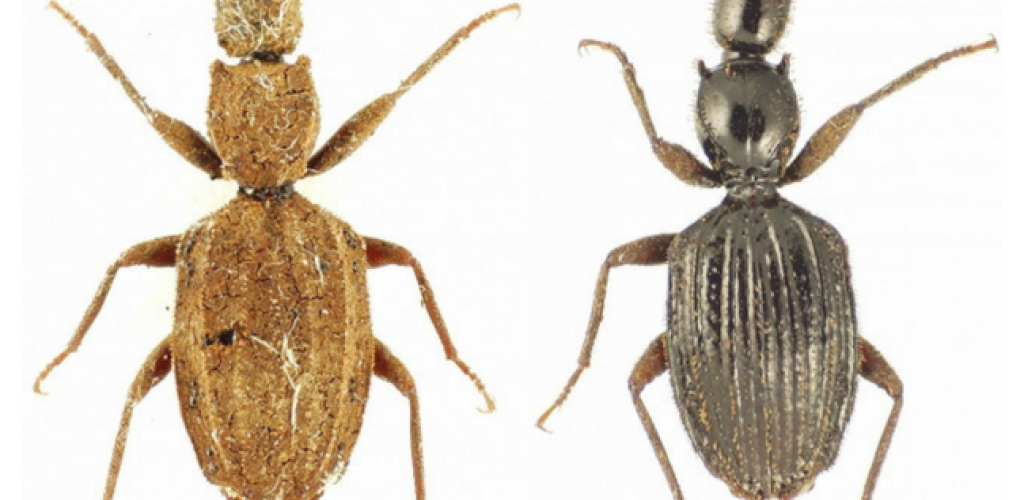
Everyone is familiar with the chameleon’s ability to alter its color to match its surroundings, but several newly described species of carabid beetle can achieve the same effect without ever changing their own hue.
The key to the beetle’s ability to camouflage itself is a naturally occurring adhesive that exudes from glands on its back, explains Professor James Liebherr in the Department of Entomology. As these Cyphocoleus carabid beetles walk through the forests of the island microcontinent of New Caledonia, the varnish-like substance exuded by cuticular glands picks up surrounding debris, such as leaf litter and bark, creating the perfect disguise to blend into its surroundings.
“You can think of these guys and gals as miniature predatory tanks, walking through the leaf litter looking for food, while being impossible to see unless they move,” said Liebherr. He published a revised taxonomy of the Cyphocoleus carabid beetles in the open-access journal Deutsche Entomologische Zeitschrift on Nov. 18.
In the paper, Liebherr describes 12 new Cyphocoleus species, adding to the 10 already known members of the genus, all restricted to New Caledonia. He is the first to propose phylogenetic relationships for these beetles which, despite their divergent morphology, are all evolutionarily related. The group itself is very old, with Liebherr hypothesizing their origins about 70 million years ago, near the end of the age of dinosaurs in the Late Cretaceous. Because their close relatives are found in Australia and South America, he hypothesizes presence of the group in Antarctica during warmer times.
The cryptic covering of the beetles was first observed by Professor Kipling Will of the University of California, Berkeley, who termed it an “environmental patina.” These beetles only release the sticky substance on certain parts of their body, notably leaving some areas clean, such as the mouthparts, the bases of the legs, and the abdomen.
“This allows the beetle to eat, walk, and mate without impairment. They can slide into tiny voids, but have the dorsal surface covered with ‘crud’ during their walkabouts,” Liebherr said.