

Baby songbirds learn to sing through trial and error by imitating their fathers, but how exactly do chick brains know when they are hitting the right notes?
A Cornell study, published Dec. 9 in the journal Science, finds that the brain chemical dopamine plays an active role in “teaching” young birds to sing.
Previous research has shown that an increase in dopamine activity reinforces actions that yield rewards – such as when a monkey presses on a lever and receives food or juice – cueing the brain to repeat that action. Similarly, when a monkey presses the lever and expects a reward but doesn’t get it, that disappointment causes dopamine levels to decrease, and discourages the action.
Until now, no one has known whether dopamine reinforces learning in tasks where an animal must evaluate whether an action matches an internal goal, such as hitting the right notes in a song.
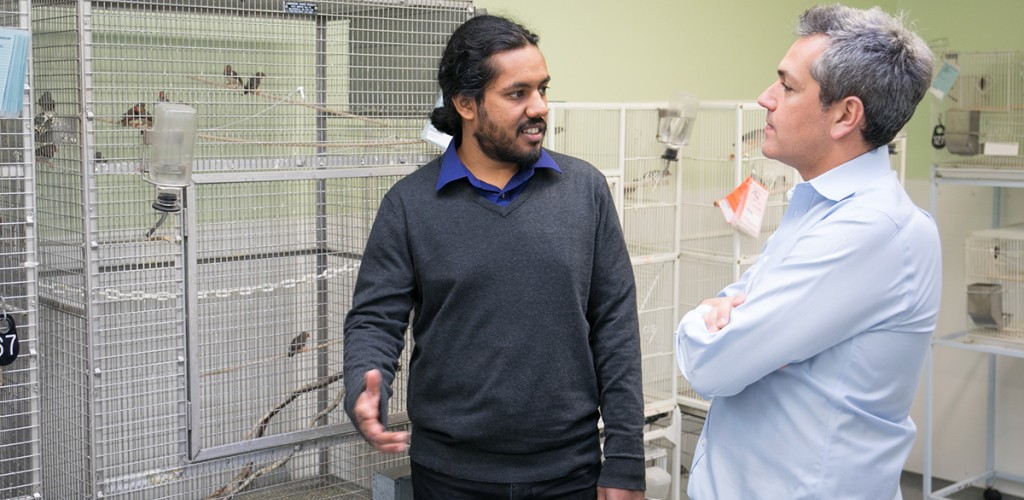
“When you are practicing piano and you play the right note, does your brain signal that note in the same way as when you’re thirsty and you get delicious juice? We found that, in the singing bird, this is the case,” said the paper’s senior author Jesse Goldberg, assistant professor and the Robert R. Capranica Fellow in the Department of Neurobiology and Behavior. Vikram Gadagkar, Ph.D. ’13, a postdoctoral researcher in Goldberg’s lab, is the paper’s lead author.
In the study, the researchers first had to trick a singing zebra finch into thinking it made a mistake. If the bird sang a tune that went “abcd,” the researchers altered the tune so it sometimes heard ”abcc.” Next, the researchers recorded the activity from single dopamine neurons while the bird practiced its song. The experiments revealed that when birds hit the right note, dopamine was released in the brain, thereby reinforcing that behavior. And, when the bird recognized that it sang the wrong note, the disappointing outcome led to a drop in dopamine levels, signaling the mistake.
Because the anatomy of the dopamine system is basically the same in birds and humans, the study may have important implications for motor and speech learning in humans.
“This is the first demonstration that dopamine evaluates the quality of nonreward-related motor performance,” Goldberg said. “Therefore the findings raise the possibility that dopamine monitors the quality of all of our movements.”
The results also invite new avenues for research on Parkinson’s disease (which results from a loss of dopamine neurons), addiction (which hijacks the dopamine reinforcement system), and obsessive-compulsive disorder (which result from pathological reinforcement of maladaptive behaviors).
The study was funded by the National Institutes of Health, Pew Charitable Trusts, Klingenstein Neuroscience Foundation, and the Simons Foundation.


