

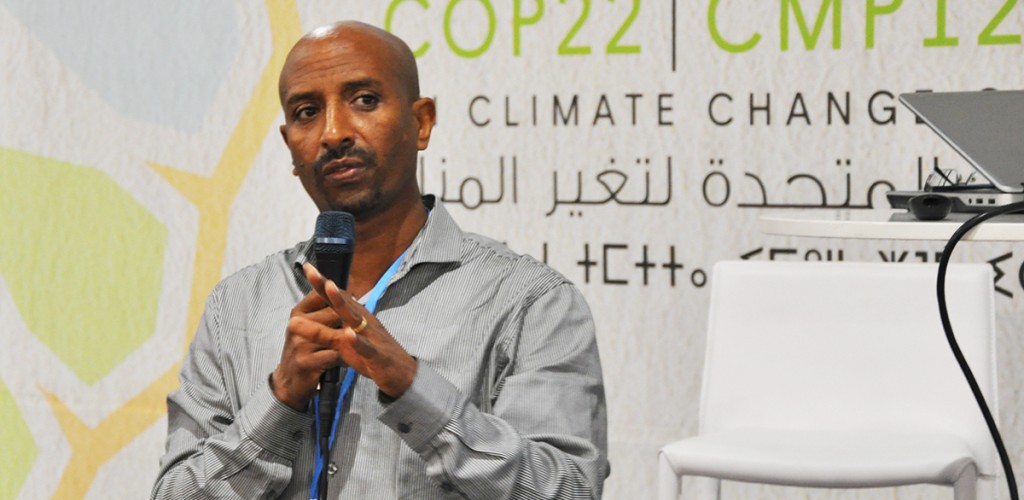
In a presentation to global leaders battling issues of climate change and feeding a burgeoning world population, Dawit Solomon, Cornell senior research associate in crop and soil science, explained food security solutions – such as adding biochar to poor agricultural soil – to combat Earth’s atmospheric warming.
Solomon presented his work at the 22nd Conference of the Parties, known as COP22, the global climate change meeting in Marrakech, Morocco.
Speaking on land-based food security interventions that can scrub carbon from the atmosphere and mitigate climate change in sub-Saharan Africa, Solomon said: “Land degradation poses a threat to more than 40 percent of the Earth’s land surface” and is a top constraint for crop production globally. The United Nations Convention to Combat Desertification, a group established in 2013, has a mandate to achieve a land degradation-neutral world by 2030. “Climate-smart, sustainable soil management is critical for achieving this goal,” he said.
The Intergovernmental Panel on Climate Change said atmospheric temperatures will likely rise 2 degrees Celsius by midcentury, and it could be 3 to 6 degrees C higher at century’s end. Solomon said the higher temperatures will be accompanied by an increasing number of extreme weather events, like drought and flooding, which will affect people, crops, and livestock.
By amending poor soil with biochar, negative carbon emissions – or carbon sequestration – can be achieved. “Enhancing food security and mitigating or adapting to climate change can be mutually supportive,” he said.
As an example, Solomon said that Ethiopia’s land-based social protection program is improving food security and livelihoods and will restore extremely degraded and uninhabitable ecosystems, all while offering carbon sequestration, climate change mitigation, and improved soil fertility.
“There is an opportunity to capitalize on land-based food security programs as a vehicle for climate change mitigation and adaptation in sub-Saharan Africa,” Solomon said.
Joining Solomon in Marrakech was Cornell’s Johannes Lehmann, professor of soil and crop sciences.
Cornell’s COP22 delegation includes six other faculty researchers and students who will attend the convention through Nov. 18. Travel funding was provided by the Atkinson Center for a Sustainable Future.


