

periodiCALS, Vol. 6, Issue 2, 2016
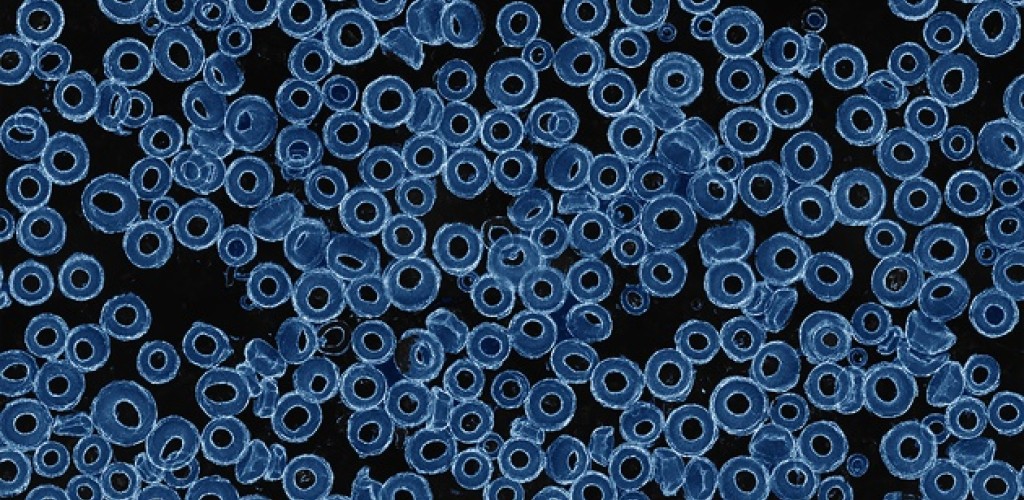
Researchers in the Department of Biological and Environmental Engineering have created a doughnut that could be good for diabetes treatment. Each only three millimeters across, the ring-shaped particles offer a new micro-capsule shape for the delivery of novel therapeutics. And like some of the world’s most important discoveries—penicillin, vulcanized rubber and Velcro, to name a few—it came about by accident.
Duo An, now a doctoral student with professor Dan Luo and assistant professor Minglin Ma, generated the first rings by accident during an undergraduate internship with Luo. One day, instead of directly injecting one solution into another, he dripped the solution and noticed vortex-ring particles forming. Two years later, he recalled the rings and wondered if they could be applied to Ma’s work on micro-capsules to deliver therapeutics that carry living cells or miniature protein factories to treat diseases like Type 1 diabetes.
Ma said that although the concept of doughnut-shaped encapsulation hadn’t occurred to him, it made perfect sense. An advantage it has over a spherical-shaped capsule is shorter diffusion distance—the distance the encapsulated particle must travel to escape the capsule—while at the same time maintaining a relatively large surface area.
“Our hope is that this type of material in these shapes can be used much more extensively in other labs for whatever they’re trying to do,” Luo said. “There is a whole field devoted to just particles, but by default, they are all thinking in terms of spherical capsules. Hopefully, this will add to that field of study.”


