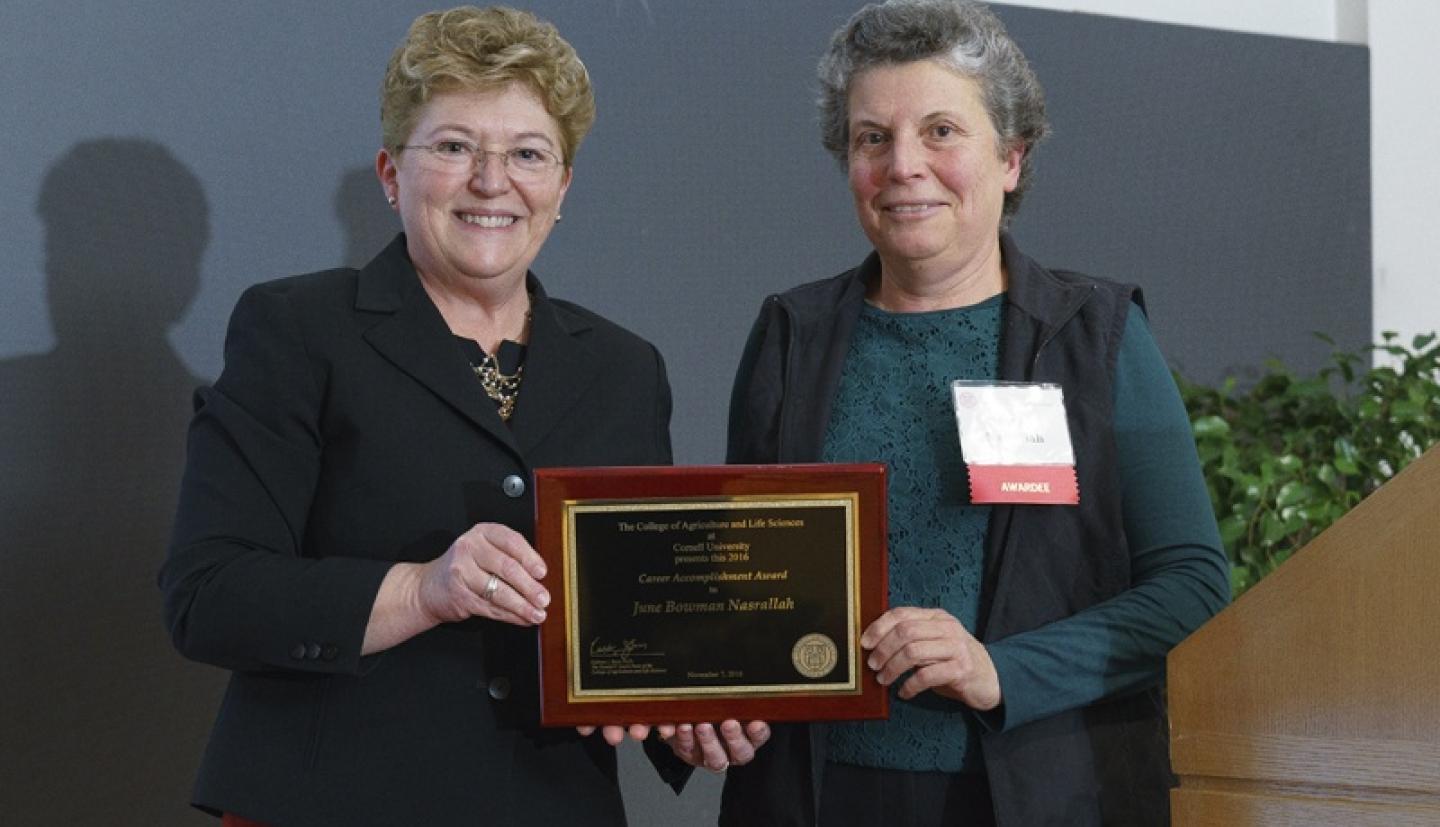
On Nov. 7, Dean Kathryn J. Boor honored June Nasrallah with the Career Accomplishment Award in a ceremony celebrating research, extension, and staff excellence. Others received awards in different categories that highlighted the best and brightest of CALS faculty and staff.
The Career Accomplishment Award is considered a capstone for individuals who have achieved extraordinary distinction for their scholarly efforts in research or extension.
Nasrallah, the Barbara McClintock Professor of Plant Biology in the Plant Biology Section of the School of Integrative Plant Science (SIPS), has made countless contributions to an understanding of the reproductive biology and genetics of several taxa within the economically important family Brassicaceae. A longtime collaborator with her husband, Professor Emeritus Mikhail Nasrallah, her recent research has focused on Arabidopsis thaliana as a model organism for the study of self-incompatibility, the diversification of floral architecture, cell-to-cell signal transduction, receptor ligand interactions, and the evolution of inbreeding. Larger ramifications of this research are in the manipulation of reproduction for crop improvement.
Her work has been published prolifically in many prestigious and influential journals, including Science, Genetics, The Plant Cell, Nature, Proceedings of the National Academy of Sciences, Current Biology, Essays in Biochemistry, and many more. In addition to her research, Nasrallah serves on a number of journal editorial advisory boards, has organized many workshops and symposia, worked on review panels, and has been invited to present distinguished lectures globally.
Not only was Nasrallah elected to the U.S. National Academy of Sciences, one of the highest honors a scientist can receive, she has also won the Martin Gibbs Medal from the American Society of Plant Biologists (ASPB). The ASPB presents the award to a scientist “who has pioneered advances that have served to establish new directions of investigation in the plant sciences.” She is also a founding member of the Lebanese National Academy of Sciences.
Dean Boor said at the ceremony that Nasrallah’s legacy is that of “a magnificent, ground-breaking scientist who is more than worthy of this award.”
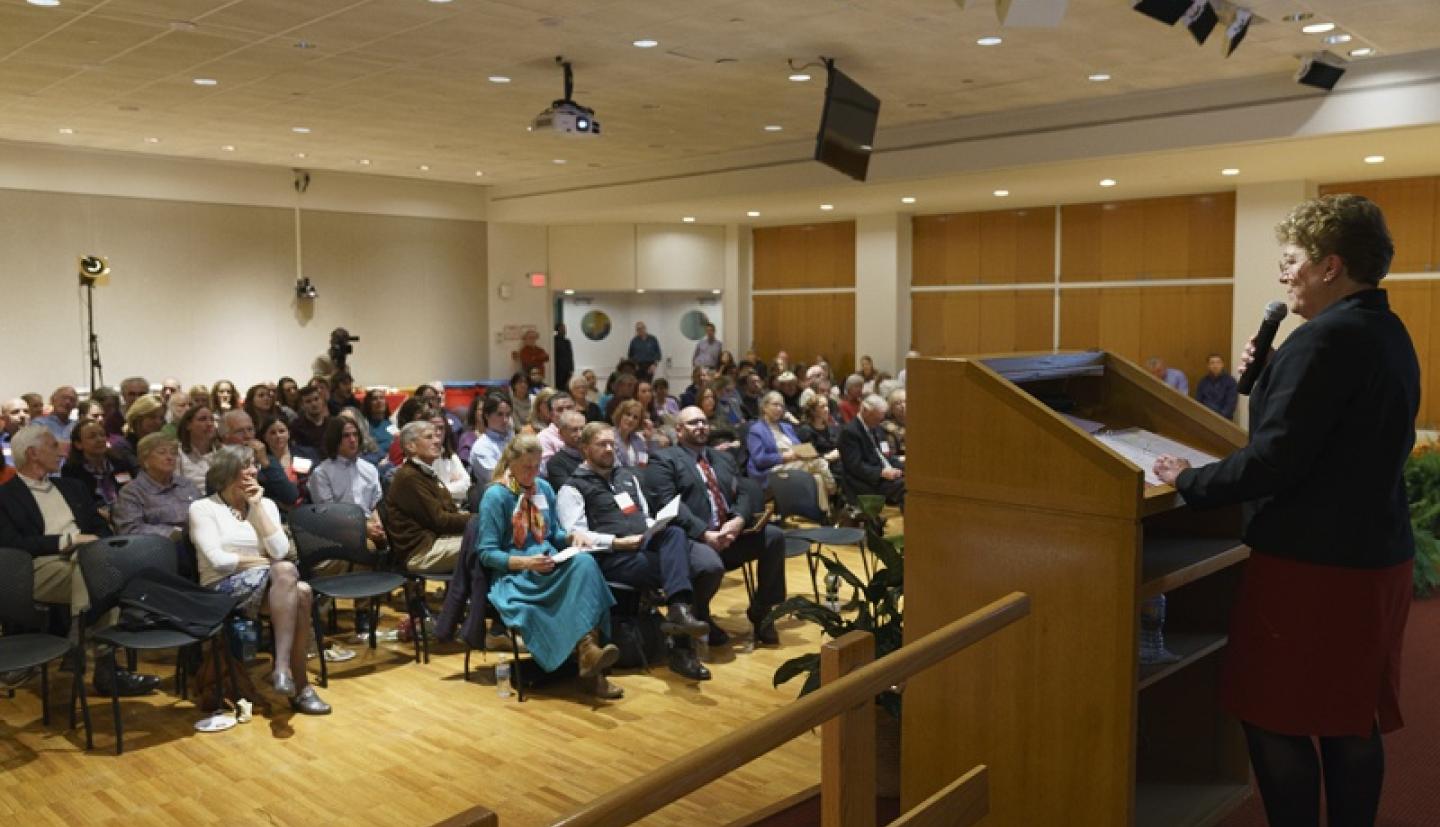
Nasrallah and 12 other CALS faculty and staff were given awards at the ceremony. The full list of winners include:
- Leah Cook, SIPS Horticulture Section: Core Value Staff Award for Job Skills
- Stefan Einarson, Office of International Programs: Core Value Staff Award for Innovation
- Cheryl Gombas, Department of Entomology: Core Value Staff Award for Service-Mindedness
- Rose Hastings, Office of Sponsored Projects: Core Value Staff Award for Stewardship
- Rachel Bezner Kerr, Department of Development Sociology: Early Achievement Award
- Quirine Ketterings, Department of Animal Science: Outstanding Accomplishment in Extension/Outreach
- Robin Lampman, Department of Molecular Biology and Genetics: Core Value Staff Award for Adaptability
- Beth Lucy-Speidel, Charles H. Dyson School of Applied Economics and Management: Core Value Staff Award for Inclusiveness
- Diane Miske, Cornell Botanic Gardens: Core Value Staff Award for Teamwork
- June Nasrallah, SIPS Plant Biology Section: Career Accomplishment Award
- Andrea Poag, Department of Communication: Core Value Staff Award for Inclusiveness
- Mike Walter, Department of Biological and Environmental Engineering: Outstanding Service to the CALS Community
- Randy Worobo, Department of Food Science: Outstanding Accomplishments in Research
Melanie Cordova is communications coordinator for the College of Agriculture and Life Sciences.