periodiCALS, Vol. 6, Issue 2, 2016

Shedding Light on Dairy
Most grocery stores have bright, gleaming cases of milk. But the bulbs illuminating those cartons and gallons could be altering the flavor and aroma of the milk, even if they are energy-efficient LEDs (light-emitting diodes). Professors Robin Dando, Martin Wiedmannand colleagues in the Department of Food Science had a tasting panel evaluate the aroma, taste and appearance of a variety of milk samples exposed to four hours of LED light or kept sealed in the dark. The results: People across the board rejected LED-exposed milk, with sensory panels describing them as “plasticky.” However, milk remained at high-quality for two weeks when shielded from light exposure. The wavelengths in the blue spectrum are suspected of activating the riboflavin and other photosensitive components in milk, releasing a cascade of electrons that can degrade proteins and oxidize fats. New light-shielding packaging may be required to balance energy efficiency and the consumer experience.
‘Archer’ on Target
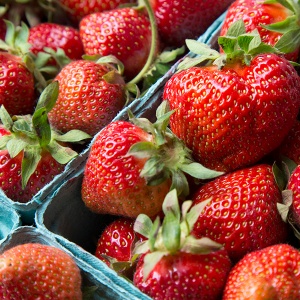
Strawberry fans, rejoice. The newest Cornell strawberry variety concentrates intense flavor in a berry big enough to fill the palm of your hand. Archer, the latest creation from Cornell berry breeder Courtney Weber, is comparable in size to a plum or small peach. This behemoth has the flavor and aroma to match its size. “Archer is an extraordinarily high-flavored berry,” said Weber, associate professor in the School of Integrative Plant Science. “It has an intense aroma, so when you bite into it you get a strong strawberry smell, and it’s very sweet, so you get a strong strawberry flavor that really makes an impact.” And this big berry is no wimp; the cold hardy variety is tough enough to withstand winters, making it suitable for growing in diverse climates throughout New York, Michigan and Minnesota and along the Mid-Atlantic from Maryland to the Northeast.
Clue from Hue
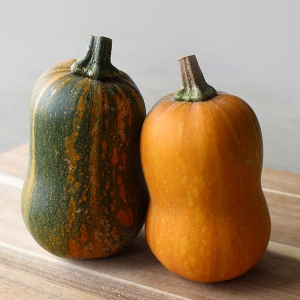
How do you know when squash is at its ripest and tastiest? Most vegetables have a unique tell. Bananas turn a summery yellow. Peaches are soft but not squishy. But squash is an anomaly in that it has no exterior indicator. At least it didn’t until Michael Mazourek, Ph.D. ’08, assistant professor in the School of Integrative Plant Science, bred one into it. All it took was a little color. Now, his honeynut squash turns from bright green to orange when ripe, signaling peak flavor and nutrition. The breeding began in the 1980s at the New York State Agricultural Experiment Station in Geneva, where Richard W. Robinson, professor emeritus of horticulture, crossed a buttercup and a butternut squash. Mazourek’s predecessor and adviser Molly Jahn, professor of plant breeding and genetics, continued the process, and Mazourek was able to finally breed honeynut as it is today. “Usually when we have people do the taste test, they say they’ve never had squash like this before—what’s the secret?” Mazourek said. “Well, it’s cooked right, and it’s ripe.”