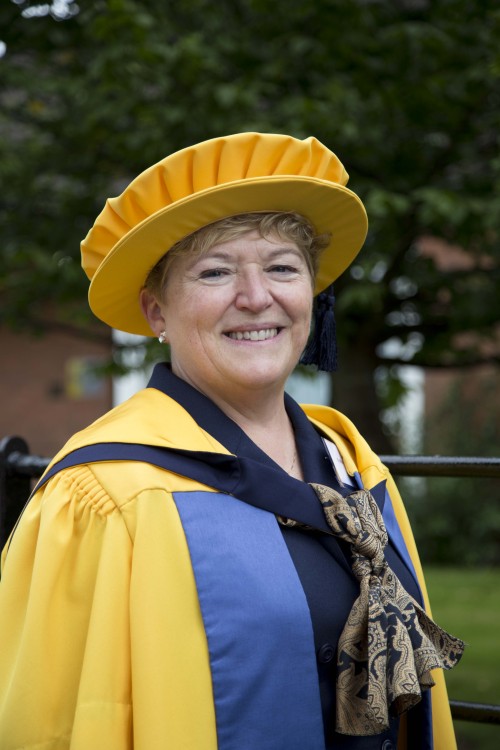
Kathryn Boor, the Ronald P. Lynch Dean of the College of Agriculture and Life Sciences, accepted an honorary doctorate from Harper Adams University on Sept. 23 in recognition of her contribution to food science and the fields of food and agricultural higher education.
Boor and three other honorary degree recipients joined hundreds of newly minted graduates during the ceremony at the university in Shopshire, England. Harper Adams specializes in the research and teaching of agriculture, sustainable food chains and the rural economy.
In presenting Boor with the honorary degree, the university noted Boor’s research into Listeria, a potentially life threatening bacterium that can be transmitted via contaminated food. Her work has helped ensure the safety of the food supply in the U.S. and around the world.
Boor’s research has focused on identifying and characterizing mechanisms that affect transmission of bacteria in food systems. Her accomplishments in tracking bacterial contaminants in food processing systems have been used to generate educational opportunities for the dairy industry.
As an assistant professor in Cornell’s Department of Food Science, Boor established the Food Safety Laboratory in 1994. She became director of the Milk Quality Improvement Program in 1997.
“It is a great honor to be receiving special recognition by Harper Adams University,” Boor said. “My career has been dedicated to the pursuit of understanding biological factors affecting bacterial transmission in food systems, with a focus on preventing the spread of foodborne pathogens.”
In recent years, CALS and Harper Adams have operated a student exchange program.
“I have greatly enjoyed mentoring emerging scientists in this vital field. We must work together to further expand opportunities for those interested in pursuing agricultural education to ensure the safety and sustainability of our future global food supply,” Boor said.
Boor earned her bachelor’s in food science from Cornell and her master’s in food science from the University of Wisconsin. In 1994, she earned her Ph. D. in Microbiology at the University of California, Davis.